Using AI in a Way You Can Trust
Using AI comes down to proving three things — whether the result can be trusted enough to put into real work, whether the gain stays with the organization and keeps running, and whether the tools are chosen critically. What each topic asks, and why, is restated at the head of its own section.
flowchart TB
  R(["🧭 How I use AI — three things to prove"]):::root
  R --> H1
  R --> H2
  R --> H3
  H1["① Problem solving · architecture  (§1)
Can the result be trusted in real work
reliability = risk management"]:::h1
  H2["② Work productivity  (§2)
Does the gain stay and keep running
personal skill → team capability"]:::h2
  H3["③ Tools · models  (§3)
Chosen knowing the limits
technical decision-making"]:::h3

  classDef root fill:#EFEBFE,stroke:#5B3FD9,color:#3B2A82,stroke-width:2.4px;
  classDef h1 fill:#EFEBFE,stroke:#5B3FD9,color:#3B2A82,stroke-width:1.5px;
  classDef h2 fill:#fdf4e8,stroke:#a8560a,color:#7a3d06,stroke-width:1.5px;
  classDef h3 fill:#eef3f6,stroke:#33505f,color:#333C52,stroke-width:1.5px;
0.Summary
Models are confidently wrong. So confidence cannot be used as a signal.
That leaves one method — make the output falsifiable, and hand it over so someone else can carry it on.
| Topic (assignment prompt) | One line | Case · evidence |
|---|---|---|
| 1. Problem solving or architecture improvement |
On a problem whose answers cannot be graded, I made every value the AI produced traceable back to its source. accuracy → replaced by traceability |
💧 Case 1 · Hydrological survey cost verification — Korea Management Analysis Institute, government budget verification · private repository Four layers of verification — source comparison · channel verification (PDFs shown as images, never extracted) · cross-file invariants · independent second estimate Invariants 38 of 42 with zero error (the rest within ±1.7%) · two different files both state 355 sites · the ~40% gap against the independent path was not tuned away but attributed to exposed variables Calculation 10 hours → 1 minute. The goal is not speed but that someone who knows nothing about hydrological surveys can verify it in an hour ✈️ Case 2 · Aviation-law RAG — the same problem under different conditions · data, code and scores all public A ground-truth set can be built, so 45 configurations were graded automatically. The retrieval axis was made free — 0 API calls On a tie, take the cheaper one — adopted a 38% token saving (which in fact ranks answers higher) · rejected agentic at 27× · the biggest variable was chunking (coverage 0.136 → 0.864) [external grading] instructor's score 9/10 for completeness · first among the course participants |
| 2. Productivity gains using AI |
I left mechanisms so the gain reproduces without me — and those mechanisms are under test right now. the metric is not hours saved but the scope that reproduces after the owner changes |
The way the same organization works — meeting notes → AI proposal → human item-by-item approval → Board Five mechanisms — division of labour (extraction by AI · Requirement Engineering by human) · approval gate · task model · two-layer leak gate · judgment recorded as ADRs What the gates actually caught, three times — overturned an assignment (domain) · filtered out internal terminology (security) · reverted "it's done" twice (completion) [stated] guideline review 10h → 2h [log] 3 ADRs · 6 learning lessons · three team repositories onto one Board And that metric is under test right now — since mid-June my available time dropped to two hours a day and two teammates joined. I am still watching how it turns out. |
| 3. Tool and model analysis |
I observed the limits myself — in a different place for each model — wrote them down, and chose knowing them. | Primary tool Claude Code — learning mode and flat-rate pricing are the reasons. Not taste, but the result of measuring tools one at a time Six limits, each on its own model — Solar claims to know what it does not · confidence ≠ accuracy · tokens grow non-linearly in agentic loops · Gemini loses numbers and relationships on long input · GPT · Gemini cannot draw logical development · local models (8B·16B) are weak on narrow domains The shared conclusion — take facts from tools and source documents; leave the model only judgment and assembly Why on-premise is separate engineering when data cannot leave the building |
| Appendix A. outside the prompt a system in production |
I applied the same principle to a system I run alone. not an organizational case, so it was moved out of the main text — but it sits on the same line |
Single-node k3s — about 20 services under *.bit-habit.com · 4 ARM cores · $0/monthWhat I asked AI for was not to build the infrastructure but to describe the running infrastructure so a third party can falsify it Three marks of a falsifiable document — leave the ❌ on the scorecard · name what you chose not to fix · commit the ordering as a decision Outage postmortem — 200 OK served the wrong site for 103 days. No check that only asked "did it respond?" could see it → checks now assert the response body, not the status code |
So the same move repeats across all three sections — never leave only the result; leave the path the result came from. §1 attached a source to every number, §2 a rationale to every decision, and Appendix A an ❌ to every box it had not done. A document that records only what went well cannot be checked against anything.
1.Problem solving or architecture improvement
What this topic asks — can the result be trusted enough to put into real work.
Two projects are laid out in the same order — background → key prompts → verification. Read one, and the other puts the same things in the same places.
- Case 1 · 💧 Hydrological survey cost verification — a government project done at the Korea Management Analysis Institute. There is no ground-truth set to grade against. (1-1 · 1-2 · 1-3)
- Case 2 · ✈️ Aviation-law RAG — a learning project built in a public repository. A ground-truth set can be built. (1-4 · 1-5 · 1-6)
I chose these two because the presence or absence of a ground-truth set splits the entire verification design. The domains (river budgets / aviation law) have nothing to do with each other, and that is what separates what the design earned from what the domain gave.
flowchart TB
  subgraph GA["💧 Case 1 · hydrology · no ground truth"]
    direction LR
    A1["1-1 Background"]:::s1 --> A2["1-2 Key prompts"]:::s1 --> A3["1-3 Verification
traceable to the source"]:::s1
  end
  subgraph GB["✈️ Case 2 · aviation RAG · ground truth exists"]
    direction LR
    B1["1-4 Background"]:::s1 --> B2["1-5 Key prompts"]:::s1 --> B3["1-6 Verification
hundreds of runs, auto-graded"]:::s1
  end
  GA --> GB
  classDef s1 fill:#EFEBFE,stroke:#5B3FD9,color:#3B2A82,stroke-width:1.3px;
💧 1-1. Case 1 Background — what the work was, and why verification was hard
- A wrong number is the risk itself — the result is evidence in a budget review, so an error is not a bug but a legal and financial risk.
- Heterogeneous sources — the standard is a PDF table (Standard Estimate Manual); the data is scattered across several Excel files.
- No ground-truth set to grade against — there is no settled value called "the true cost of this survey".
- The verifier is not a developer — someone who cannot read code has to be able to trust the result.
- Data cannot leave the building — it is client material, so the repository is private too.
1-1-1 · What a hydrological survey is
- Hydrological survey — a national program that repeatedly measures discharge at river sites.
- Discharge — how many m³ of water pass that site per second.
- Where it is used — flood forecasting · dam release decisions · water allocation · river planning.
- Scale — several hundred sites nationwide. Repeated every year. Funded every year.
1-1-2 · What cost verification is
- The budget is built on a per-site annual unit cost — "how much to survey one site for one year".
- The bidding contractor submits its own cost estimate.
- A third-party institute independently re-estimates the same cost — that is the role of the Korea Management Analysis Institute.
- The two values are compared, over-estimated items are identified, and the findings are presented to the government with evidence.
The point is to trace everything back to the standards the state has published, not to instinct or custom.
- A national standard that fixes how many people and how many hours a given task takes.
- Wages are multiplied onto it and overheads added. This is called the cost-plus-fixed-fee method.
- In other words, it works back not from "what was spent" but from "what it should be by the standard".
flowchart LR
  A["Allocated budget
per-site annual unit cost
money actually set aside"]:::a
  B["Back-calculated from the Manual
cost-plus-fixed-fee
money the standard implies"]:::b
  A --- Q{{"The two differ
at which assumption?"}}:::q --- B
  Q --> T["Trace each assumption back to the source
measurement count · staffing · adjustment factors …"]:::t
  classDef a fill:#fdf4e8,stroke:#a8560a,color:#7a3d06,stroke-width:1.3px;
  classDef b fill:#EFEBFE,stroke:#5B3FD9,color:#3B2A82,stroke-width:1.3px;
  classDef q fill:#EFEBFE,color:#3B2A82,stroke:#5B3FD9,stroke-width:2.4px;
  classDef t fill:#eef3f6,stroke:#33505f,color:#333C52,stroke-width:1.3px;
1-1-3 · What the app did · did not do
| What it did not do | What it did |
|---|---|
| Rule on which side is right | Put the two values side by side and let the source of the difference be traced |
| Substitute "the AI calculated it" for evidence | Attach the source document and cell to every assumption |
Three things are traced — how many measurements were assumed, how many people and hours per measurement, and which adjustment factors were applied. Change an assumption and the screen shows how the numbers move.
- The output becomes evidence in a budget review.
- So a wrong number is not a bug but a legal and financial risk.
- The reader is a non-developer who cannot read code.
1-1-4 · The previous method (10 hours → 1 minute)
- The current procedure is manual Excel work. No code, no AI.
- It takes more than 10 hours per case.
- Estimation and checking happen in the same hands, inside the same sheet. So even when an error creeps in, it has nowhere to surface.
- Above all, no one but the person who produced the result can readily check it.
Once the logic is set up, estimation takes a minute, and all the time left goes to asking "where did this number come from".
| Previous (manual Excel) | The app | |
|---|---|---|
| Estimation | over 10 hours | 1 minute |
| Verification — hydrology expert | not separated from estimation | about 10 minutes |
| Verification — non-expert | effectively impossible | about 1 hour ← this is the real goal |
That last row is the actual goal of the project: letting someone who knows nothing about hydrological surveys verify the work within an hour, just by following the evidence the app presents. It is about increasing the number of people who can verify.
1-1-5 · There is no ground-truth set
- There is someone who judges — an experienced verifier decides after looking at the evidence.
- But there are no labels to grade against in advance — no settled value called "the true cost".
- All that exists is the calculation procedure fixed by law — and even its application leaves room for interpretation.
- So accuracy cannot be measured automatically. A person has to look.
So I replaced accuracy with traceability. Instead of grading whether a value is right, the criterion became whether every number can be traced back to its source — because if it can be compared by eye, you can say it is wrong even without knowing the right answer.
💧 1-2. Case 1 Key prompts — demanding verification before code
- The AI's answer — a Streamlit app and the three screens (1-minute · 10-minute · final) came out as asked, but it fixed the purpose wrongly as a "tool for understanding the total budget".
- Five corrections followed — fix the purpose → narrow the scope to a single survey → reject coordinate citations → render PDFs as images → express every calculation as a formula.
- In all five, the AI was wrong first, and I found it by using the app.
1-2-1 · The first prompt, verbatim
Instead of a polished summary, the first prompt is kept raw. It came from audio dictation, so the sentences are rough and there are typos ("파악을 할 수 있느", "validtion") — which is exactly why it shows the flow of thought rather than a conclusion. Only the key parts are highlighted. (One internal data folder name is masked.)
강 별로 수문조사들을 한 것들이 다 저장되어 있는 데 너무 내용이 많고 그 예산이라고 할만한 부분도 카테고리가 너무 많다. 그래서 이 전체적으로 파악이 안되는데. 파악을 할 수 있느. 어떻게 보면 1분만에 이해할 수 있는 적절한 spread sheet와 인사이트를 보여주는 html을 만들어주고, 그 후 10분 정도 시간 들여서 이해할 수 있는 html도 만들어주고. 그 다음에 결국에는 궁극적으로 내가 원하는것은 1개 강의 수문을 조사시 몇명이 몇시간 얼마의 비용이 들어가는지 분석하는 것이다. 하지만 이게 바로 하게 되면 환각이 일어날수도있고, 이게 나름의 방정식일텐데 이해하기가 어려울 수도 있다. 마치 선형회귀로 서울 아파트 가격을 예측할때 다양한 feature들을 고려해서 더 정확하게 예측할 수 있겠다만, 그러면 이해가 안되니 heuristic하게 일단 size만 가지고 예측하는 것처럼. 처음에는 아주 간단한 마치 하나의 feature 고려하는 것처럼 정확도는 떨어지더라도 validtion이 될 수 있는 방향으로 해야겟다. html을 만들때 아무래도 streamlit으로 해야될 거 같으니. 아까 말한것과 다르게 html이 아니라 streamlit으로 만들어줘. 다시한번 말하는데 validation이 가장 중요하니, 가 문장의 근거는 실제 [내부 데이터]를 한번 가공해서 그 데이터를 매번 citation해줘.
Original prompt, in Korean — kept verbatim.
The line of thought inside that one paragraph
- There is too much data to see the whole Many files, and the budget categories are chopped far too finely.
- So I asked for the forest and the tree at once It will take a while anyway, so get both out of a single wait. The AI is good at the overall structure; I adjust the details.
- Why not ask only for the detail? The narrower and deeper the result, the more easily it diverges from what I wanted. And if the AI invents plausible numbers, there is no way to notice.
- So I asked first for a form I could check Even at some cost in accuracy, I must be able to follow where a value came from. Even if it fails, the overall context remains as material for the next turn.
- In the end what matters most is verification Before building fast comes whether the result can be trusted.
- So I made it attach a source to every number Which file, which cell a value came from is shown on screen alongside it.
- I switched tools mid-request too Static HTML → Streamlit. Because I need to change values and see the effect.
Not a single line about code. Every requirement is about "how will I trust this", not "what shall we build".
1-2-2 · Why I asked for the forest and the tree at once
This is the most misread part. It does not mean "make me three screens", nor "I will cross-check three results".
- The wait happens only once — a large request takes a long time anyway. That single wait returns both the final target (the tree) and the overall context (the forest). With luck, the tree arrives right away.
- The more local it is, the more it misses — detailed calculations get built while the AI still does not know what I want. Narrow and deep means easy to diverge.
- The overall structure it usually gets right — pulling a skeleton out of scattered material is something it does well. So the forest is delegated and only the tree is adjusted.
- Failing costs nothing — even if the tree misses, the forest remains. That forest becomes material the AI refers to in the next turn, so the same background never has to be explained again.
- What it makes
- Totals and unit costs by river and year, summarized on one screen
- Who reads it
- The decision-maker. One minute, no explanation
- Why delegate it
- Pulling an overall structure out of scattered material is what AI does well
- What it makes
- Which items sum to that total, with a source citation on every value
- Who reads it
- Practitioners. They follow the numbers down to the source
- Its role
- The stair from forest to tree. Which item to dig into is decided here
- What it makes
- How many people · how many hours · how much — a unit cost built up from the statutory manual
- Who reads it
- The cost negotiation with the contracting authority
- Its role
- The basis for a ruling in that negotiation — "what the law implies", presented with the formula
1-2-3 · How the three screens actually came out
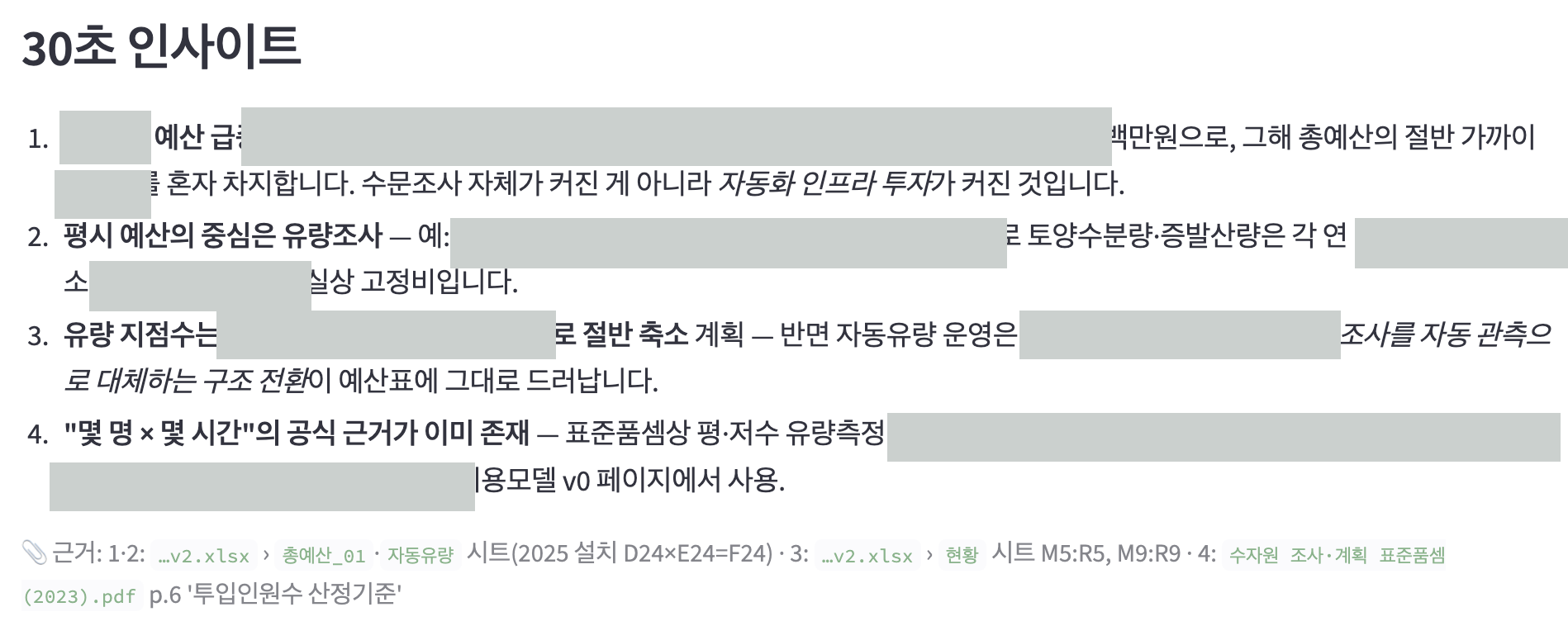
D24×E24=F24). All figures here are masked. Even reading only the remaining sentences, you can see what this screen does — every conclusion carries where it came from. And this screen was not a showpiece: the fourth item found that "the Standard Estimate Manual already prescribes person-days per measurement", and it ends with → used on the cost model v0 page. The key to the final calculation was picked up in the forest.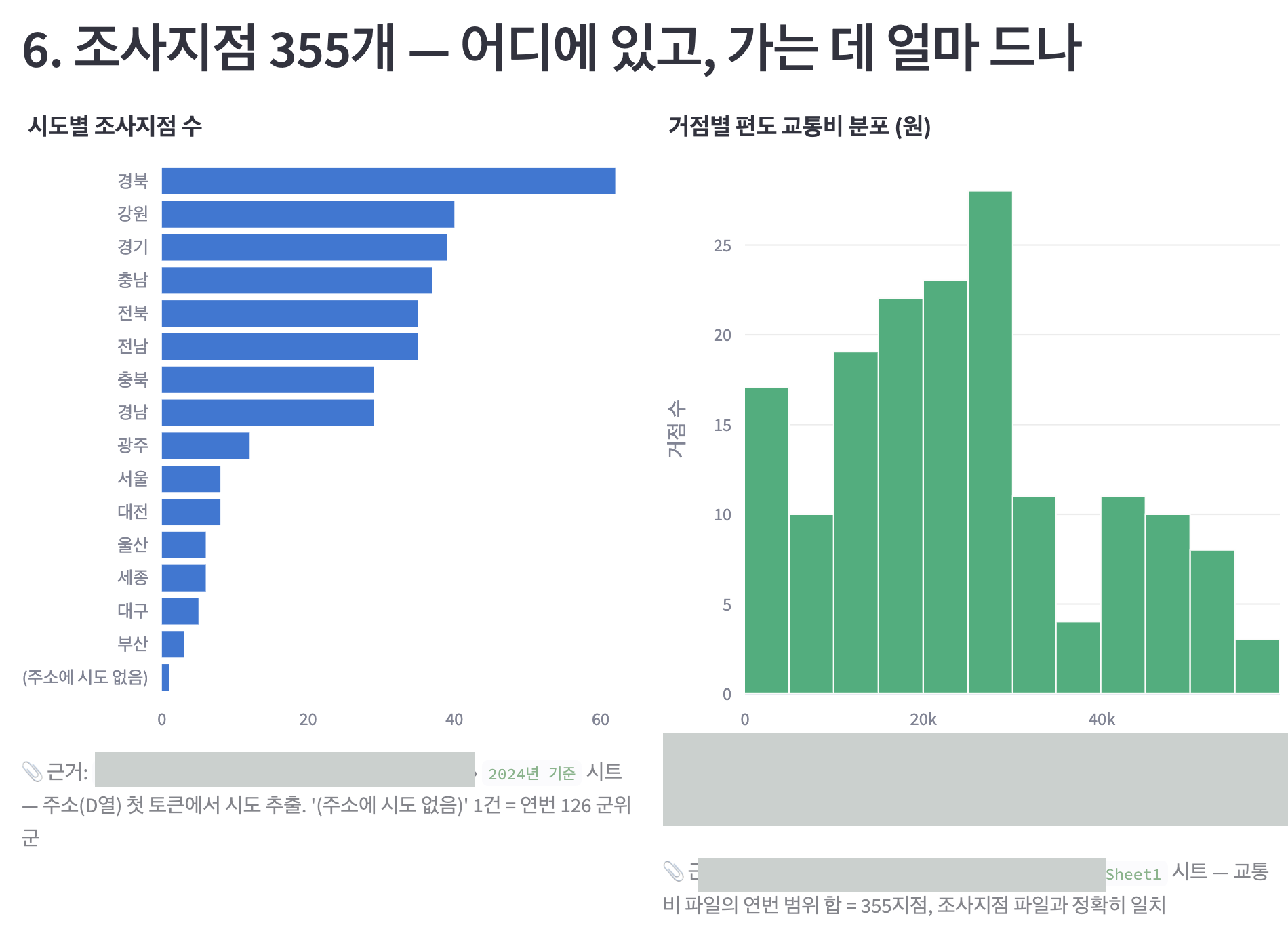

The conversation that followed is carried below in 1-2-4~1-2-8 as raw (masked) text, and the outcome is organized in 1-3 — the process of turning back an AI that had mistaken the purpose, refusing coordinate citations, and distrusting the extraction channel itself.
How the conversation developed — five corrections
In every one, the AI was wrong first and I found it and changed direction.

1-2-4 · Misreading the purpose itself
아이고 니가 목적을 완전히 헷갈렸는데 … 우리가 원가 검증을 하는 프로젝트를 하고 있거든. 이 예산이 실제 그 법령하고 맞는지를 항상 보는 …
Original prompt, in Korean — kept verbatim.
- Not "fix what you built" but "change the objective function itself".
- I nailed down that the purpose is not "a tool for understanding the total budget" but "verifying whether this budget conforms to the statutory standard".
- A polished app appeared in about 50 minutes — but the framing was wrong. The artifact looked plausible while the objective function was off.
- How I found it — by using the app, not by reading the code. What the app emphasized clashed with my sense of the domain, and having a prior expectation made the mismatch visible.
- The corrected purpose was written into project memory — so it persists into later conversations.
- The demand "I want to know whether the data really says that" produced the raw Excel viewer.
- Pages were versioned rather than overwritten, so earlier conclusions survive.
1-2-5 · Narrowing the scope to an atom
누가 그냥 todo를 해줘. 비용모델은 1개 강의 수문 조사시 몇명이 몇시간 얼마의 비용인지 부터 아는거로 하자.
새로운 비용모델을 만들자. 즉 매우 지엽적인 수문 1개 조사시에 몇명이 몇시간 얼마의 비용이 들어가는 지. 즉 특정 수문을 현재 조건을 보고 법령에 맞게 실제로 나오는지. 다른 예산은 일단 필요없다.
Original prompt, in Korean — kept verbatim.
- Fix the output first — how many people · how many hours · how much. Not what to build, but what must come out.
- Fix the criterion for judgment — "does it come out as the law says".
- Exclude the rest explicitly — "the other budget items are not needed for now".
- With a criterion in place, the later verification becomes comparison — without one, verification is only impression.
- If the scope is not closed in words, the AI widens it on its own — once closed, increasingly narrow models stacked up as v0 → v1 → v2.
- The raw viewer and question history became separate pages, so earlier stages are never erased.
1-2-6 · Evidence that cannot be falsified
그 근거라는 부분을 spreadsheet의 일부를 복사붙여넣기 해서 누구나 spreadsheet에서 온 것처럼 해줘. … 새로운 수식이 나오면 그걸 근거를 보여줘
Original prompt, in Korean — kept verbatim.
- Attach the source fragment itself, not a coordinate string.
- Whenever a new formula appears, produce its evidence with it.
- What was wrong — the citations were coordinates like
📎 source: unit-price table D4. It looks rigorous but cannot be checked on the spot, and above all a fabricated coordinate is outwardly indistinguishable from a real one. - What changed — collapsible excerpts that preserve the Excel rows and columns, with cited rows in pale yellow and cited cells in deep yellow.
- Present it in the screen the worker already knows — if the source is Excel, show it like Excel. Verification only actually happens when the reviewer does not have to learn a new UI.
- Derived questions ("why are there two kinds of measurement") were answered by the fact that only two rows exist in the source.
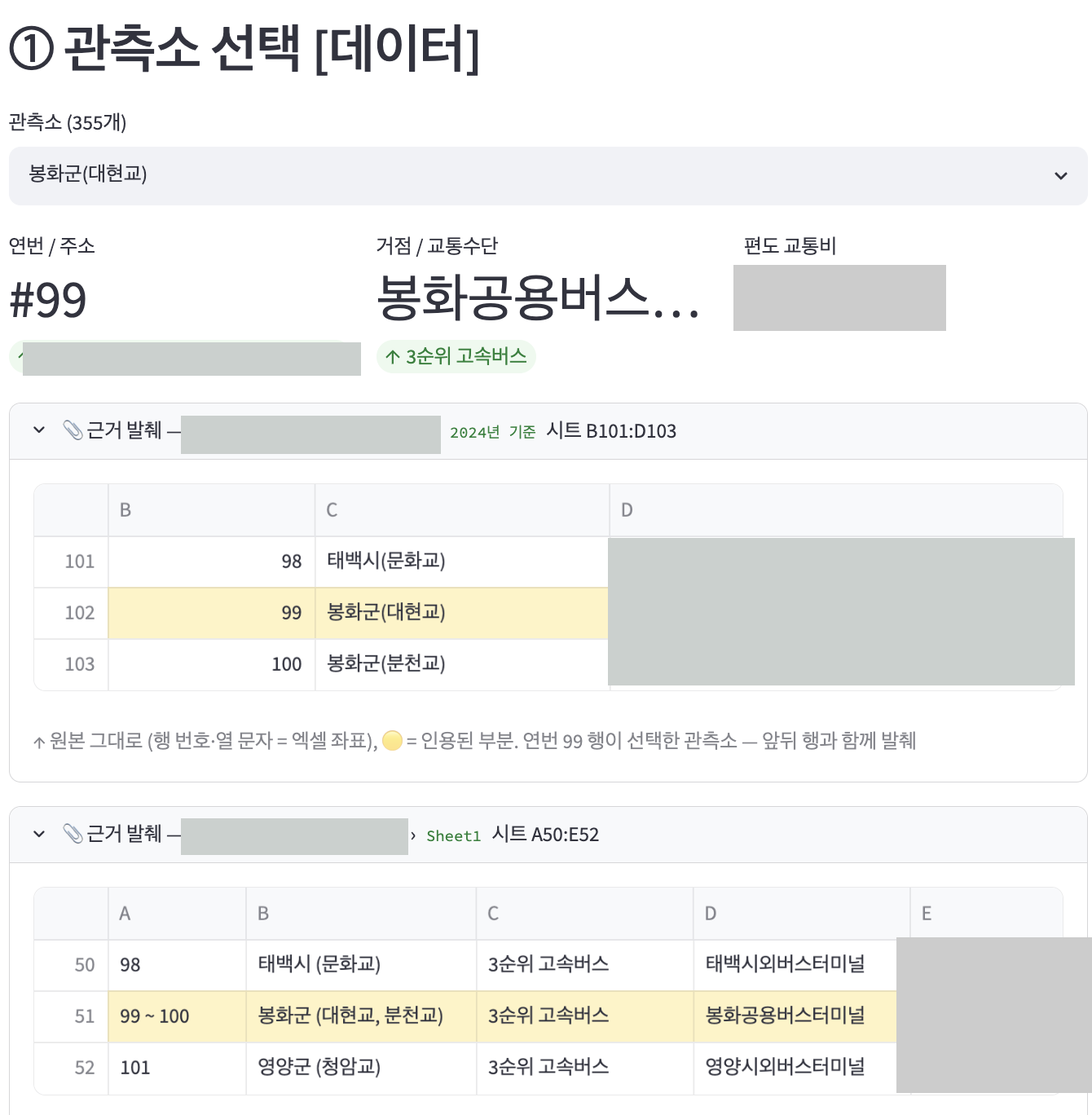
B101:D103) along with the rows before and after the cited one — you need the neighbours to judge whether a value was truncated or is simply like that. Amounts, addresses and internal file names are masked; the grid structure is exactly as in the source.1-2-7 · Do not trust text extraction — show the source as it is
pdf는 확실히 표로 되어 있으니 읽기가 어렵네. pdf는 스크린샷도 그냥 찍어서 근거로 보여주라
Original prompt, in Korean — kept verbatim.
- Exclude the text-extraction channel from PDFs out of the evidence path entirely.
- The reason is single — when it fails, it does not raise an error. A plausible string comes out and the calculation keeps running.
Extracting the staffing table as text actually produces this.
(1) 평ㆍ저수 유량측정회0.050.650.850.90②●- There are six grade columns but only four values — no way to tell which value belongs to which grade. One shift, and the entire labour-cost calculation is quietly contaminated.
- The rule changed — PDF evidence is always the source page as it is. A table looks like a table, the line spacing is intact, and there is nothing to worry about regarding what the extractor dropped.
- The values themselves were re-extracted in layout-preserving mode and confirmed against the source (total 2.45 person-days). But the evidence shown on screen is always the source image.
- Leaving only the source gives no clue where to look, so the cited phrase alone is highlighted. The images are generated by a script — they are rebuilt if the source changes.
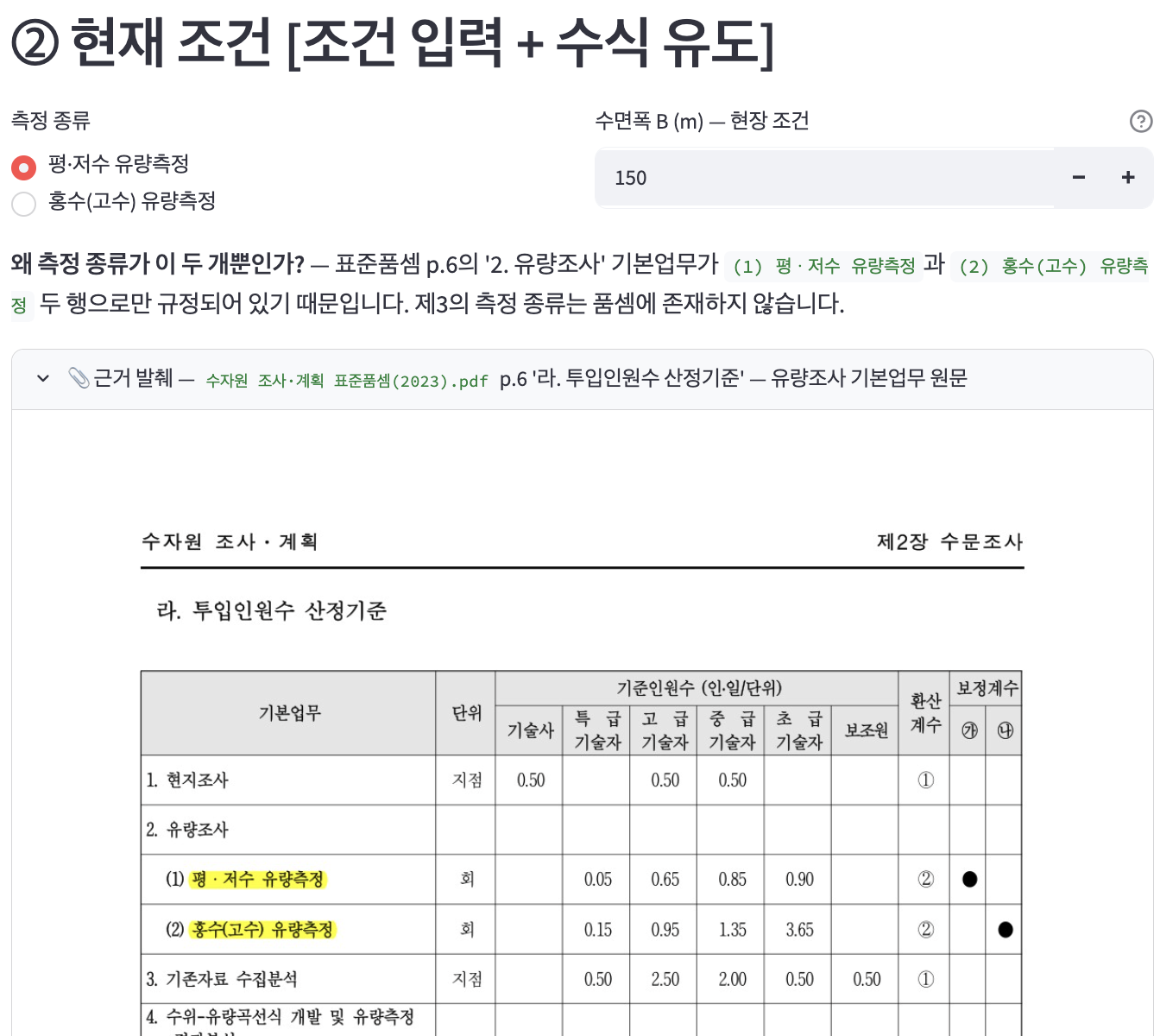
- Right now the source page is shown as a screenshot with only the cited part highlighted, and a human compares it directly. Nothing passes through an extractor, so there is no path for contamination.
- But it only works for humans. The moment a machine has to read the value again, we are back to the extraction problem.
- That is exactly the place for a dedicated parser such as Upstage Document Parse — a product that solves the point where general-purpose extraction fails silently.
1-2-8 · Demand the formula, not the result — so the evidence, not the answer, can be compared
현장 출동인원이 몇명이 필요한지는 원래 알 수 없나? … 적용보정계수 같이 수식으로 계산한것들은 그 수식까지 표현해야지. 모든 수식은 다 표현해줘.
Original prompt, in Korean — kept verbatim.
- I demanded three columns — formula → substituted numbers → result — not a result number.
- I pressed on the origin of default values that sat there without evidence.
- If only the result is given, the only way to check is to recompute everything, and for a reviewer that amounts to being told not to check.
- Review became comparison rather than recomputation. Where each term's number came from is confirmed on its own line, and a mismatch only requires pointing at that term.
- A side effect — constants without evidence surfaced.
- Finding — "on-site crew size" was hard-coded to the default
3. There was nothing to write in the formula slot as evidence. - Check — the Standard Estimate Manual prescribes only cumulative person-days; it does not fix how many people work simultaneously.
- Derivation — a range from the data. Assuming completion within one day, and since people cannot be split,
⌈2.45⌉ = 3 people, with an upper bound of4given the grade composition.
A constant was turned into a derivation. Without demanding the formula, that spot would never have been visible.
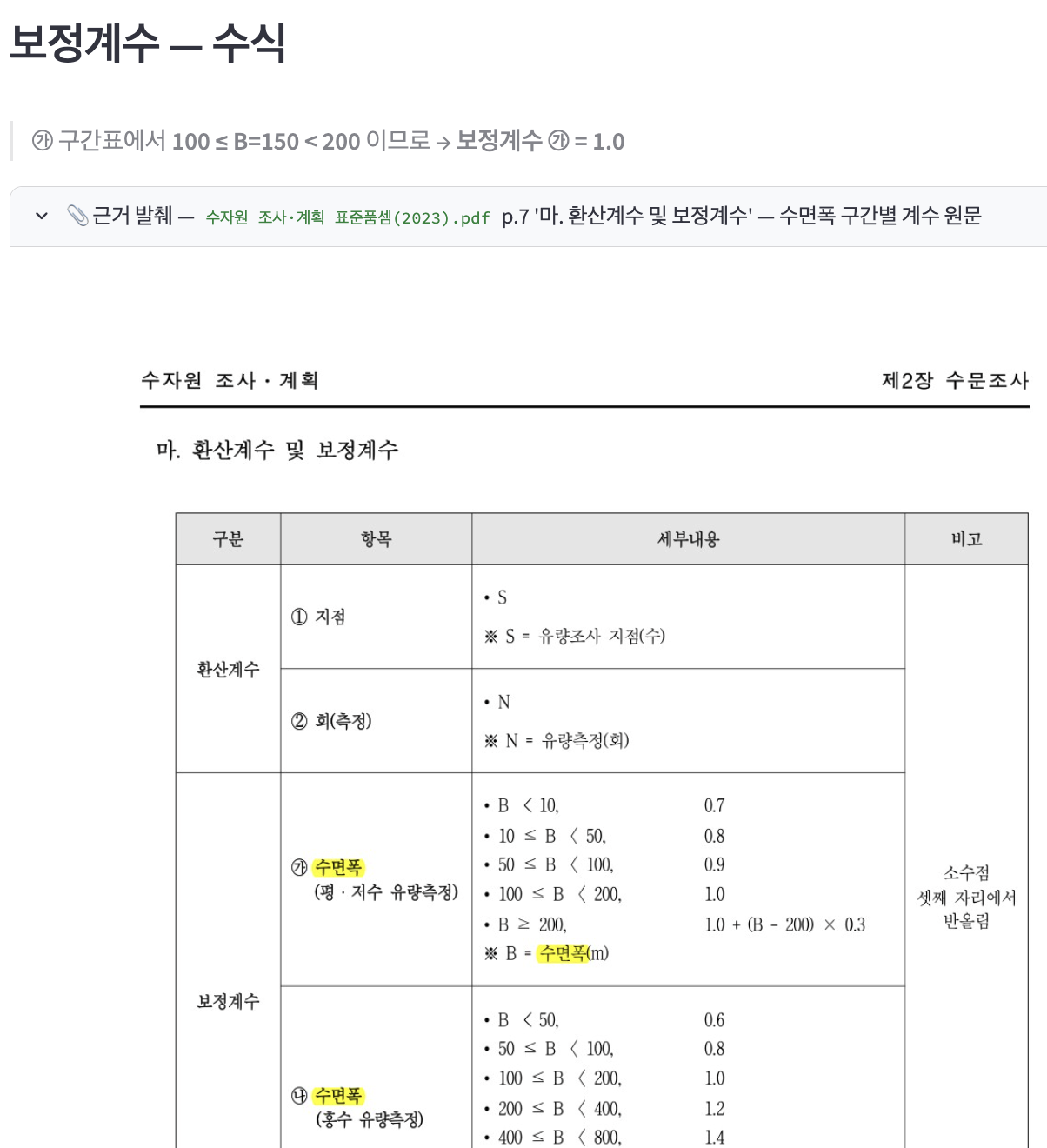
1.0 gives no way to check why it is 1.0, but unfolding the decision rule alongside makes the evidence comparable right there: 100 ≤ B=150 < 200 → factor 1.0. Page 7 of the published manual, the source of the rule, is attached as the original image.💧 1-3. Case 1 Verification and rollout — four layers before it reaches real work
- Source comparison — the cited cell is excerpted with its Excel row and column coordinates intact and pinned on screen.
- Channel verification — PDFs are not extracted as text; the source page is shown as an image.
- Cross-file invariants — a machine checks whether different files state the same fact (38 of 42 with zero error).
- Independent second estimate — the same value is derived by a second path that never looks at the budget.
- After rollout — feedback from the reporting session with the decision-maker (a non-developer) becomes the input to the next cycle.
1-3-1 · How to read this section
This is the core of the work — the validation that AI output passes through before it enters real use. In an environment where data cannot leave the building and a wrong value is immediately a legal and financial risk, reliability was not a feature but a requirement.
Since there is no single correct answer, nothing can be scored. Instead every value is made traceable to its source, so that if something is wrong, a person can find where.
flowchart TB
  A["AI output"]:::src
  A --> B["Source comparison
excerpt keeping row·column coords"]:::dev
  A --> C["Channel verification
PDF as image, table intact"]:::dev
  A --> D["Cross-file invariants
do other files say the same"]:::dev
  A --> E["Independent 2nd estimate
a path that never sees the budget"]:::dev
  B --> F["Put into real use"]:::ok
  C --> F
  D --> F
  E --> F
  D -.->|"mismatches are not hidden"| G["published as known data issues"]:::warn
  classDef src fill:#eef3f6,stroke:#33505f,color:#333C52,stroke-width:1.3px;
  classDef dev fill:#EFEBFE,stroke:#5B3FD9,color:#3B2A82,stroke-width:1.3px;
  classDef ok fill:#5B3FD9,stroke:#3A2A7A,color:#ffffff,stroke-width:1.4px;
  classDef warn fill:#fdf4e8,stroke:#a8560a,color:#7a3d06,stroke-width:1.3px;
Below is the actual code — not a claim, but how it runs. (File names and amounts are parameters, so nothing is exposed; the logic is unchanged.)
1-3-2 · Source comparison — show the cited cell in its original grid
flowchart LR
  Q["cell to cite
e.g. E9"]:::inp --> R["raw_slice
keeps Excel row no. · column letter"]:::act
  R --> S["_row_style
called for every table row"]:::act
  S --> T{"is this cell
in the cited list"}:::dec
  T -->|"cell matches"| U["deep yellow + bold"]:::ok
  T -->|"row only"| V["pale yellow"]:::ok
  T -->|"no"| W["no colour"]:::inp
  classDef inp fill:#eef3f6,stroke:#33505f,color:#333C52,stroke-width:1.2px;
  classDef act fill:#EFEBFE,stroke:#5B3FD9,color:#3B2A82,stroke-width:1.2px;
  classDef dec fill:#fdf4e8,stroke:#a8560a,color:#7a3d06,stroke-width:1.3px;
  classDef ok  fill:#eaf6f0,stroke:#0a7048,color:#08512f,stroke-width:1.2px;
  classDef bad fill:#fdeeec,stroke:#a3241d,color:#7a1a15,stroke-width:1.2px;
def evidence(rel_file, sheet_name, row_from, row_to, col_from="A", col_to=None,
             note="", expanded=False, hl_rows=None, hl_cells=None):
    """Attach evidence as an excerpt of the original spreadsheet, highlighting cited rows (pale yellow) and cells (deep yellow)."""
    if hl_rows is None:
        hl_rows = []
    if hl_cells is None:
        hl_cells = []
    rows = set(hl_rows)    # Excel row numbers to highlight
    cells = set(hl_cells)  # cell coordinates to highlight (e.g. "E9")
    df = raw_slice(rel_file, sheet_name, row_from, row_to, col_from, col_to)

    # callback pandas Styler calls per row (same role as a function pointer argument in C)
    def _row_style(row):
        out = []
        for col in df.columns:
            cell_name = col + str(row.name)  # column letter + row number = cell coord (e.g. "E9")
            if cell_name in cells:
                out.append("background-color:#ffd54a; font-weight:600")  # cited cell
            elif row.name in rows:
                out.append("background-color:#fff3c4")                   # cited row
            else:
                out.append("")
        return out
# → an invented coordinate and a real one are separated by colour on screen.
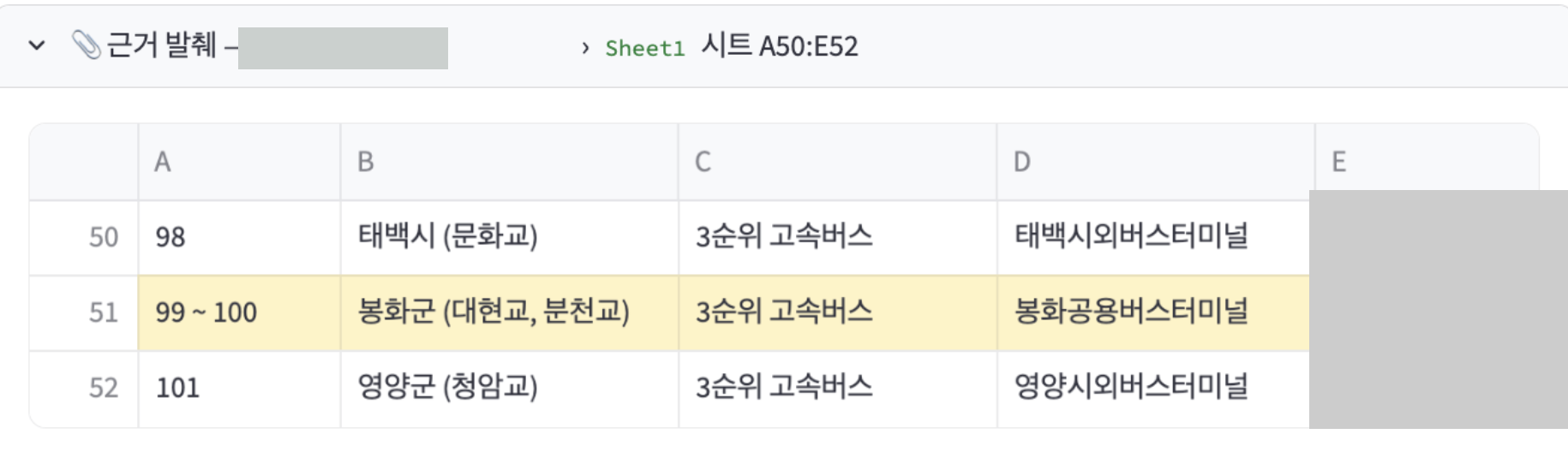
_row_style rendered directly as colour. Keeping the neighbouring rows (50·52) was deliberate too. Internal file names are masked.1-3-3 · Channel verification — distrust the extraction path itself
flowchart LR
  A["PDF evidence requested"]:::inp --> B{"is there a rendered
image of that page"}:::dec
  B -->|"yes"| C["show the image as is
table layout survives"]:::ok
  B -->|"no"| D["fall back to extracted text
accept that tables may break"]:::bad
  classDef inp fill:#eef3f6,stroke:#33505f,color:#333C52,stroke-width:1.2px;
  classDef act fill:#EFEBFE,stroke:#5B3FD9,color:#3B2A82,stroke-width:1.2px;
  classDef dec fill:#fdf4e8,stroke:#a8560a,color:#7a3d06,stroke-width:1.3px;
  classDef ok  fill:#eaf6f0,stroke:#0a7048,color:#08512f,stroke-width:1.2px;
  classDef bad fill:#fdeeec,stroke:#a3241d,color:#7a1a15,stroke-width:1.2px;
def evidence_pdf(label, txt_name, note="", expanded=False, hl=None):
    """PDF evidence: show a page screenshot (cited part highlighted). Fall back to text if absent."""
    title = "📎 근거 발췌 — `표준품셈(2023).pdf` " + label
    with st.expander(title, expanded=expanded):
        png = DATA / (txt_name + ".png")
        if png.exists():
            st.image(str(png), width='stretch')      # the image as is — nothing breaks the table
            st.caption("↑ PDF 페이지 스크린샷 (etl.py가 렌더링, 🟡 = 인용 문구). " + note)
        else:
            st.code(_read_txt(txt_name), language=None)  # fallback: machine-extracted text
            st.caption("↑ PDF에서 기계 추출한 원문. " + note)

# raw_slice — slice into a 2-D array keeping Excel coordinates (row number, column letter) alive
data = []           # data[row][col]
row_names = []      # Excel row numbers as the index
for r in range(row_from, row_to + 1):
    line = []
    for c in range(c0, c1 + 1):
        line.append(ws.cell(r, c).value)
    data.append(line)
    row_names.append(r)
1-3-4 · Cross-file invariants — do different files state the same fact
This first checks whether the baseline the last mechanism will use is sound. The per-site unit price in the budget table is not a value to accept just because it is written down, and if the baseline is wrong, however precisely the gap (%) is computed it means nothing.
Where the previous three mechanisms make things checkable by a person, this check catches things even when nobody looks. A self-consistent hallucination cannot pass it.
| Invariant checked | How | Result |
|---|---|---|
quantity × unit price = total | Recompute the product without looking at the total cell, then compare | 38 of 42 exact · 4 within ±1.7% |
| Number of survey sites | Counted separately from the site-status file and from a separate travel-cost file | Both give 355 |
| Before / after revision | Row-by-row comparison | 7 mismatching rows printed individually |
| Missing values | Check whether the address carries a province | 1 case found |
flowchart TB
  A["row list: records"]:::inp --> B{"any blank among
qty · price · total"}:::dec
  B -->|"yes"| S["not eligible — skip"]:::inp
  B -->|"no"| C["model = qty × price
the total cell is not read"]:::act
  C --> D["err = total − model"]:::act
  D --> E{"is the error below 0.5"}:::dec
  E -->|"yes"| F["exact-match count +1"]:::ok
  E -->|"no"| G["update max error rate, publish"]:::bad
  classDef inp fill:#eef3f6,stroke:#33505f,color:#333C52,stroke-width:1.2px;
  classDef act fill:#EFEBFE,stroke:#5B3FD9,color:#3B2A82,stroke-width:1.2px;
  classDef dec fill:#fdf4e8,stroke:#a8560a,color:#7a3d06,stroke-width:1.3px;
  classDef ok  fill:#eaf6f0,stroke:#0a7048,color:#08512f,stroke-width:1.2px;
  classDef bad fill:#fdeeec,stroke:#a3241d,color:#7a1a15,stroke-width:1.2px;
# Cross-file invariant check: quantity × unit price = total. Recompute the product without reading the total cell, then compare.
records = items.to_dict("records")  # DataFrame → array of dicts (iterated like an array of structs in C)
n_exact = 0         # count of rows matching with zero error
max_err_pct = 0.0   # maximum error rate (%)
for i in range(len(records)):
    row = records[i]
    qty, price, total_val = row["수량"], row["단가_백만원"], row["총계_백만원"]
    if pd.isna(qty) or pd.isna(price) or pd.isna(total_val):
        continue  # if any of the three is blank, the row is not eligible
    model = qty * price          # these are facts stated by different cells, so
    err = total_val - model      # a self-consistent hallucination cannot satisfy this equation
    if abs(err) < 0.5:
        n_exact = n_exact + 1
    if total_val != 0:  # rows with a zero total are excluded from the error rate
        err_pct = abs(err) / total_val * 100.0
        if err_pct > max_err_pct:
            max_err_pct = err_pct
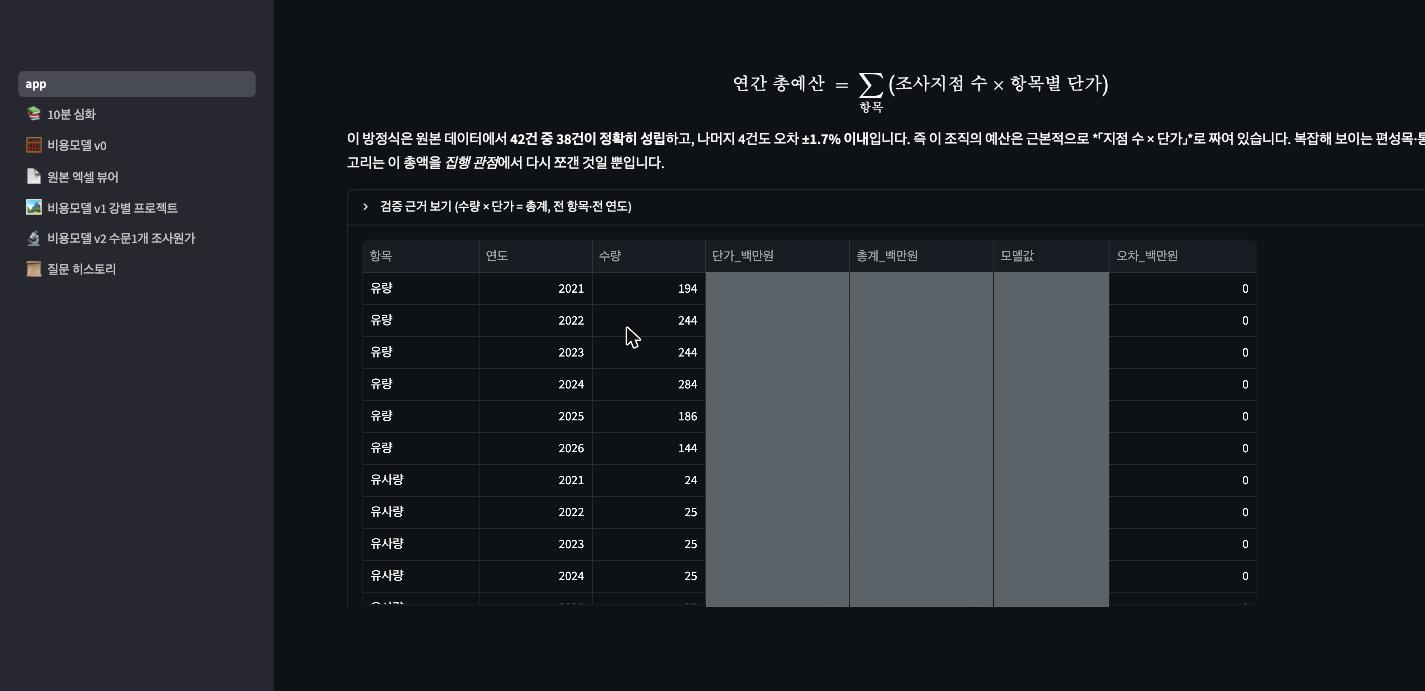
quantity × unit price, without reading the total cell, matches the original total. The sentence above is its summary (38 of 42 with zero error, the other 4 within ±1.7%). The unit-price, total and model columns are masked because they are internal budget amounts, but what this mechanism proves is not those values but the equation among the three, so masking leaves the argument intact.How the 4 mismatches were handled
| Where | They were not random but clustered in one item group — the new programme line being converted to automated measurement. |
|---|---|
| Why | The total is not an Excel formula but a separately computed value, and the unit price is that value rounded to an integer for display, so dividing the total by the quantity diverges below the decimal point. |
| Outcome | A single equation caught a 0.13% difference no eye would find — and narrowed it down to which item group, at that. |
| Therefore | The items used as the baseline held with zero error across all years. The divergences were not in the baseline, so the final comparison could proceed as planned. Without this check, there would have been no way even to ask whether the baseline was sound. |
The [data] / [assumption] labelling convention settled here
| What | Values with a confirmed source are distinguished on screen from assumptions that were filled in. |
|---|---|
| Why | When verification fails, "is the data wrong or is the assumption wrong" has to be separated immediately. Mixed together, that is impossible. |
| In practice | When the AI plausibly filled in a particular unit price without a source, that value was marked [assumption] and left editable by the user. |
1-3-5 · Independent second estimate — reach the same answer by two paths
The same cost is computed by two paths that know nothing of each other. Like debit = credit in double-entry bookkeeping, or two independent witnesses.
top-down · based on tender material
bottom-up · never sees the budget
| Path A · from the budget | Path B · from the law | |
|---|---|---|
| Direction | top-down — allocated budget → per-site unit cost | bottom-up — Standard Estimate Manual × published wage rates → cost |
| Input | Tender material | Published law and published wage rates — never sees the budget |
| Precondition | A's unit price is used as the baseline only after the check in 1-3-4. If the baseline is wrong, the gap is meaningless. | |
| If the two agree | They have verified each other. | |
| If they differ | It is a signal of where something is wrong. In practice a gap of about 40% appeared, and rather than forcing the model to match, the causes of the gap (published wage rates · measurement counts · water-surface width) were exposed as adjustable variables and attributed. | |
flowchart TB
  L["Manual person-days
by grade"]:::inp --> M["× adjustment factor
derived from width band"]:::act
  M --> N["× published wage rates
summed by grade = direct labour"]:::act
  N --> O["× overhead·fee + travel"]:::act
  O --> P["annual cost
the budget has never been read"]:::ok
  P --> R{"gap = annual vs UNIT
how far apart"}:::dec
  U["allocated unit cost UNIT
an entirely separate source"]:::inp -.-> R
  R --> Z["expose the causes as adjustable variables"]:::act
  classDef inp fill:#eef3f6,stroke:#33505f,color:#333C52,stroke-width:1.2px;
  classDef act fill:#EFEBFE,stroke:#5B3FD9,color:#3B2A82,stroke-width:1.2px;
  classDef dec fill:#fdf4e8,stroke:#a8560a,color:#7a3d06,stroke-width:1.3px;
  classDef ok  fill:#eaf6f0,stroke:#0a7048,color:#08512f,stroke-width:1.2px;
  classDef bad fill:#fdeeec,stroke:#a3241d,color:#7a1a15,stroke-width:1.2px;
def once_cost(task_name, fct):
    """Payment for one measurement (travel included, VAT excluded) — the budget is never read."""
    r = labor[labor["업무"] == task_name].iloc[0]  # one row for this task from the manual
    dl = 0.0                                       # running sum of direct labour cost
    for g in GRADES:
        man_days = float(r[g]) * fct               # person-days by grade × adjustment factor
        dl = dl + man_days * wages[g]              # × published wage rate → accumulate
    cost = dl * (1 + ovh_rate) * (1 + fee_rate) + team * fare * 2
    return cost

# Direct labour for per-site fixed tasks: double loop over task rows × grades
fixed_records = fixed_tasks.to_dict("records")
fixed_dl = 0.0
for i in range(len(fixed_records)):
    r = fixed_records[i]
    for g in GRADES:
        fixed_dl = fixed_dl + float(r[g]) * wages[g]

annual = (n_py*cost_py + n_hs*cost_hs + fixed_cost) * vat_mult  # annual cost derived from the law alone
gap = (annual - UNIT) / UNIT * 100      # UNIT = allocated unit cost (value lives elsewhere). Difference between the two paths (%)
# → annual has never seen the budget. That is why the gap is a real signal.
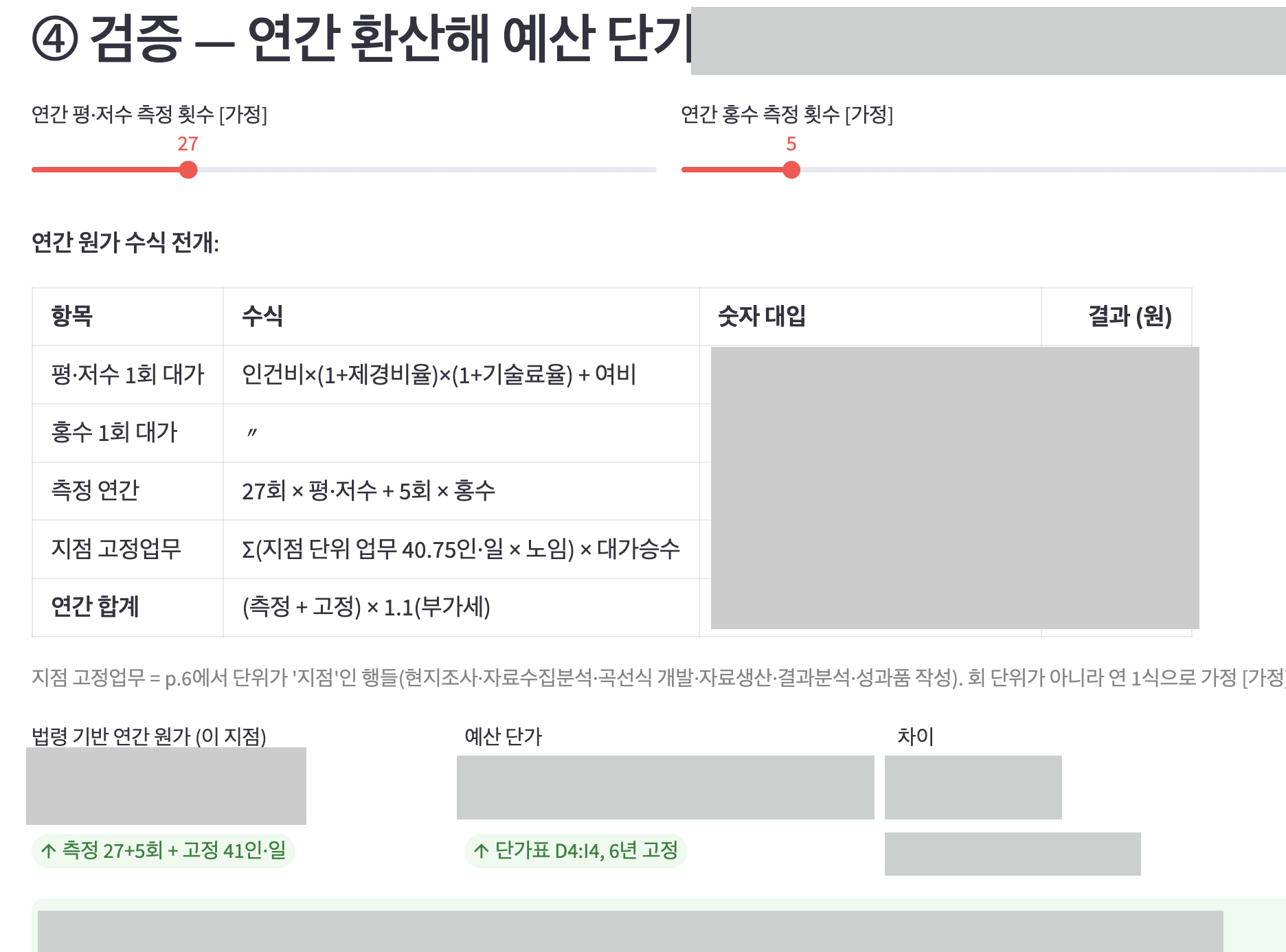
cost ÷ (1+gap). So absolute amounts, ratios and component items all have to be masked together. The item and formula columns are kept, because this section's claim is about structure, not values — once you can see which terms sum to the annual cost and which formula each term comes from, the screen is verifiable without the numbers.1-3-6 · The screen that passed four layers
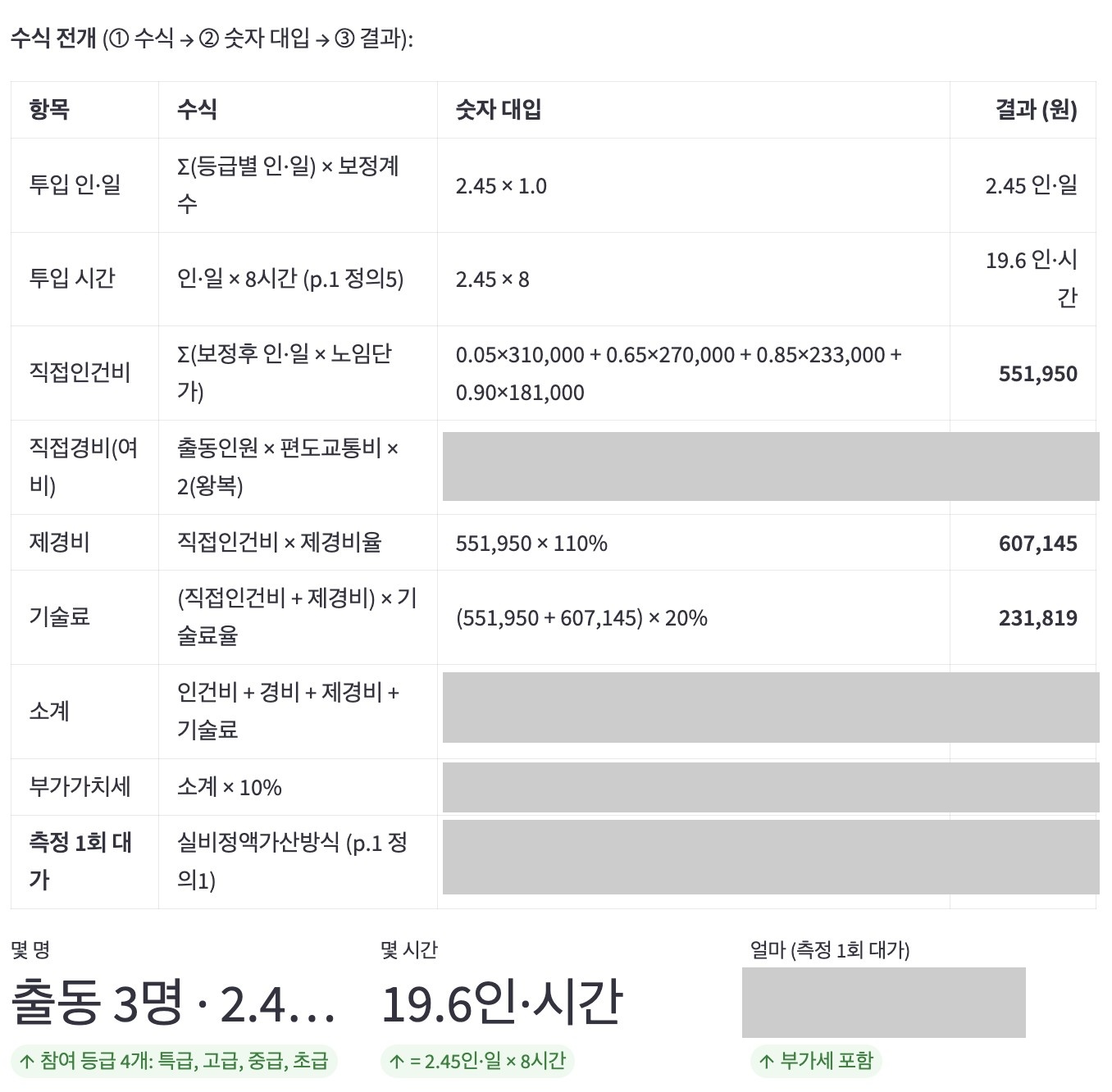
1-3-7 · After rollout — decision-maker feedback
The four above are verification before shipping; this is after. What is said here becomes the input to the next cycle.
The analysis closed with a results briefing to the decision-maker, a non-developer. There were three points. (Names and amounts masked; summarized, not verbatim.)
✈️ 1-4. Case 2 Background — finding the right clause in 1,297 pages of regulation
- Where it splits from Case 1 — here a ground-truth set can be built. The clause sits in a settled document, so this is comparison, not interpretation.
- Many combinations — chunking × embedding × retrieval method × top-K multiplies to dozens. Not a flaw but a design challenge: you can't pick by eye, so you narrow it by experiment.
- Grading costs money — measuring answer quality needs an LLM judge, and repetition accumulates charges.
- Self-authored bias — I built the ground-truth set myself, so it inherits my bias directly.
The ground-truth set, the grading code and the results for all 45 configurations are public, so everything described in 1-5 and 1-6 can be reproduced.
Two reasons not to stuff it all in — long inputs the model doesn't fully read (§3-3 limitation ④), and feeding it every time is expensive. So it is "find and feed," not "feed it all."
To find and feed, the code has to be prepared in advance. The terms that keep recurring below (1-5·1-6) are exactly those assembly parts.
| Part | What it does (analogy) | Where the choice is |
|---|---|---|
| ① Split chunking | Cut 1,297 pages into searchable pieces — breaking a book down to sticky-note size | Cut on § clause boundaries, or by character count? Performance turns on this. |
| ② Index embedding | Turn each piece into a meaning coordinate — a map that places similar meanings close together | Which embedding model. Even with no shared words, close meaning still matches. |
| ③ Retrieve search method | Pull the pieces that fit the question | By meaning (vector) · by word (keyword) · blend (hybrid) |
| ④ How many top-K | How many top pieces to hand over as grounds | Too few drops the grounds; too many lets noise in. |
| ⑤ Score LLM judge | Whether the answer is good is graded by another model — a grader instead of a person | Accurate, but it costs money every call. |
1-4-1 · What this project is
- Corpus — the US Federal Aviation Regulations, 14 CFR. 1,297 pages in the original.
- Task — a RAG that answers a question by finding the clause (§) that supports it.
- Context — a learning project in a public repository, and a submission to a course contest.
- How it differs from 💧 — data and code are entirely public, so anyone can reproduce the claims in this document.
1-4-2 · What was at stake
- Regulation must not be wrong — pointing at the wrong clause makes someone break a rule in fluent prose.
- Plausible and correct look the same — the sentence reads smoothly even when the clause cited is wrong.
- So judging by eye does not scale.
1-4-3 · A ground-truth set can be built
- The answer can be written down in advance, like "the governing clause is §91.151" — the clause sits in a settled document, so this is comparison, not interpretation.
- With a ground-truth set, verification stops being something you look at and becomes an experiment you run overnight.
- So the bottleneck shifts from "can it be trusted" to "there are too many configurations".
✈️ 1-5. Case 2 Key prompts — asking not about the answer, but where it came from
- "At what ratio?" — asked for a concrete number, the AI opened the code, and what it had described as RRF was actually an
alpha=0.5weighted sum. Five places in the public docs were corrected. - Taking back a judgment the AI deferred — the agentic version had better quality but cost 27× the tokens, so it was rejected.
- Putting rules in configuration, not conversation — an instruction that worked once was moved into a config file so it survives into the next session.
This section shows the principles set in 1-2 operating in the same places even as the domain changes. Here too the prompts are kept raw, typos and dictation artefacts included.
1-5-1 · Catching a description that differed from the code
Context — the AI described the hybrid search as RRF (rank fusion), and that description went straight into five places in the public documentation: diagrams, glossary, body text. Yet reading it, I never quite got it.
아니, 내가 궁금한건 앙상블을 어떻게 한지 아직 이해안돼. 어느 비율로 어떤 것을 쓰고, 언제 어떤 임베딩을 썼나?
Original prompt, in Korean — kept verbatim.
- "Explain it" only produces the same explanation once more. I demanded a concrete value: the ratio.
- A concrete value cannot be answered without opening the code — the question forces the source, not the prose, to be the evidence.
- That is where it collapsed — the implementation was not RRF but an
alpha = 0.5weighted sum: normalize scores to 0–1 and add them in halves. - The AI's own diagnosis — it had assumed "RRF is what people usually use" without reading the code.
- All five already-published places were corrected.
- Correction boxes rather than deletion — "this is what we believed until we read the code and fixed it" has to remain visible, because that is the signal that the rest of the text was verified too.
- Refusing to leave anything not understood is itself a verification mechanism — an explanation you cannot follow was usually one the explainer had not checked either.
1-5-2 · Taking back a judgment the AI deferred — rejecting agentic
Context — after implementing agentic RAG itself and showing a quality advantage, the AI handed the decision over with Your call. Which way should we settle on?
지금 에이전틱으로 하면 그래도 10배 정도의 토큰 소모가 있는거 아니가? 우리는 단일 래그로 했을 때 복잡한 문제도 이미 잘 풀었다는것을 확인했어. 이정도 데이터에서는 에이전틱 루프 보다는 단일 래그도 잘 된다면 굳이 토큰 많이 써가면서 에이전트를 붙일 필요성ㅇ ㅣ있을까?
Original prompt, in Korean — kept verbatim.
- I took back the judgment the AI had handed over. The point is to put quality and cost on the same scale instead of looking at quality alone.
- The criterion has to be measurement rather than taste, so I cited token counts that had already been measured.
- 81,320 tokens on a broad question — 27× the single-shot path.
- That measurement was not made in order to adopt anything — it was added under time pressure as "let's at least build something simple", and it became the grounds for rejection.
- Discard but keep — the code was committed as
harness/agent_rag.pyand only dropped from the deployment. It will be needed again once the corpus grows.
1-5-3 · Put rules in configuration, not conversation
Context — I was running two sessions at once. One handled experiment code, the other documentation, both on the same repository. That leads to one session committing the other's unfinished work.
그리고 너가 커밋할때는 너가 작업한것만 올려줘. 너가 작업하지 않은건 그대로 둬
claude-memory-backup 에서 커밋 관련된 모든 엠디 파일에 '한 세션에서는 그 세션이 작업한 것만 커밋한다'는 것을 추가해줘.
Original prompt, in Korean — kept verbatim.
- First nail down the commit scope — and then do not stop there.
- Promote an instruction that worked once into a config file, so it stays alive in the next session.
- The document-update procedure became a rule the same way — wired as a pre-action hook that must run before publishing. Not "just leave a marker," but a gate you cannot pass until the check clears.
- If the rule stopped the symptom, what changed the structure was worktrees — running several sessions in parallel kept committing files that weren't theirs. Giving each session its own working tree (
git worktree) makes touching another session's files impossible to begin with. Parallel sessions have run on worktrees ever since. - Why do it this way — an instruction given in conversation disappears when that conversation ends. What does not reproduce is a habit, not a system.
- the explanation was fluent but differed from the code (RRF ↔
alpha=0.5), - the implementation had good quality but its cost was never put on the same scale,
- and an instruction that worked once vanished when the conversation ended.
✈️ 1-6. Case 2 Verification and rollout — with a ground-truth set, grade hundreds of runs automatically
- A secret exam — of 14 holdout questions, 4 were never used for tuning, and for 3 the correct answer is refusal.
- Cheap grading separated from expensive grading — retrieval grading is a code comparison, 0 API calls. The expensive LLM grading was only touched after retrieval was settled.
- Rollout — on a tie, the cheaper one. A configuration 38% cheaper in tokens was adopted, and the result was collected back as an instructor score (9/10).
Where verification in Case 1 was about making things traceable by a person, here it is about making them gradable by a machine. Two mechanisms were built, and 45 configurations were run on top of them.
1-6-1 · A secret exam — set aside questions never used for tuning
Holdout — sitting the exam with questions you tuned on inflates the score. So a few questions are set aside from the start as a "secret exam" used only for grading, never for tuning. I wrote 14 by hand and split them by purpose into three.
| Questions | Purpose | Why split |
|---|---|---|
| 4 | Final exam — never used for tuning (split:"final") | Fitting configurations to the remaining questions makes you strong only on those questions. Studying from the exam paper raises the score, not the ability. |
| 3 | Refusal is the right answer — out-of-scope questions | Measuring only how well it answers puts the model that bluffs about what it does not know in first place. |
| 7 | For tuning | The questions used to fit configurations. |
The refusal questions weren't there at first — I was only writing in-scope questions until I realized late that "does it avoid making up an answer to an out-of-scope question" also had to be tested, and added them.
1-6-2 · Cheap grading / expensive grading, separated
| Retrieval grading retrieval | Generation grading generation | |
|---|---|---|
| What is measured | Is the correct § among the retrieved results | The quality of the answer actually produced |
| Grading method | Compared in code — local embeddings | LLM judge |
| Cost | 0 API calls · $0 | Charged per call |
| Execution | All 45 configurations, overnight | Only the few survivors, after retrieval was settled |
Because retrieval grading runs in code, all 45 configurations were swept for $0, and the paid generation grading was spent only on the few survivors — the same volume of experiments at roughly a tenth of the cost. That said, neither the generation grading nor checking that the grading is right is free, so this is less "completely free" than calling the expensive grader as little as possible.
1-6-3 · Result — on a tie, the cheaper one
Coverage = the fraction of correct clauses retrieval actually found (found ÷ total correct). MRR = how high the correct answer ranked in the results (closer to 1 the higher). Both are retrieval grading, scored in code — which is why they could be applied to all 45 configurations.
| Configuration | Coverage | MRR | Tokens |
|---|---|---|---|
| § boundary · bge · hybrid · K8 | 0.864 | 0.636 | 17,284 |
| § boundary · bge · vector · K5 — adopted | 0.818 | 0.718 | 10,802 |
| char count · minilm · hybrid · K3 (last) | 0.136 | 0.182 | 2,939 |
| Judgment | Grounds |
|---|---|
| The difference is marginal | A coverage gap of 0.046 against first place (K8) — across 11 questions, effectively one question. Not a gap wide enough to decide on. |
| The adopted one is better | First place packs 8 chunks of evidence (K8), so it responds slowly. The adopted K5 uses 38% fewer tokens and answers faster, while ranking the correct answer higher (MRR 0.718 vs 0.636). It loses only 0.046 in coverage — put usability on the scale too and K5 wins. |
| On a tie, the cheaper one | In an on-premise deployment, both inference cost and response latency are product constraints. |
| Rejected for the same reason | The agentic retrieval loop grows tokens roughly quadratically (about 81k · 27× the single-shot path), too expensive for the gain. The deployment is single-shot; the loop was kept as a documented experiment. |
| The biggest variable | Chunking. Switching from character count to § clause boundaries moved coverage from 0.136 to 0.864. In regulation the clause is the unit of meaning, and cutting at 1,000 characters slices across it. |
1-6-4 · After rollout — the instructor's score
Same here. After the automatic grading was done, what a person pointed out became the starting point of the next improvement.
- Accuracy — the ground-truth set is still 14 questions. Scaling it up (say 100×) makes grading finer-grained and separates even subtler differences between configurations.
- Quality of the set — if someone else, and specifically someone who knows aviation law, writes the questions, the exam gets harder and free of my bias.
- Cost — there is still room to cut tokens further — how far it can go I never pushed to the end.
1-7. What the two cases leave behind
Different conditions split the verification method. Here is where they split, on one page.
| Case 1 · 💧 hydrology cost verification | Case 2 · ✈️ llm-app-lab RAG | |
|---|---|---|
| Domain | River budgets · government standards | Aviation law (14 CFR) |
| Ground-truth set | None | Can be built (holdout) |
| Verification method | A person traces back to the source | Code grades automatically |
| Bottleneck | Can it be trusted | Too many configurations · grading costs money |
| What is the same | Never trust AI output as given — make it falsifiable | |
2.Productivity gains using AI
- Misinterpretation — an ambiguous sentence asserted with confidence.
- Information leakage — internal terminology spilled into a public repository.
- Premature "done" — declared finished while work remained.
What this topic asks — does the gain remain as team capability rather than personal skill. And for that, how far can work be delegated to AI.
flowchart LR
  M{{"productivity = the scope that reproduces
after the owner changes"}}:::root
  M --> P["Meeting notes
where decisions are made"]:::s2
  P --> A["AI — read and propose
quoting the supporting sentence"]:::s2
  A --> V["Human — judge
approve · question · reject, item by item"]:::gate
  V -->|"only what is approved"| B["GitHub Projects board
where the record lives"]:::s2
  V -.->|"ask back if ambiguous"| P
  classDef root fill:#EFEBFE,color:#3B2A82,stroke:#5B3FD9,stroke-width:2.4px;
  classDef s2 fill:#fdf4e8,stroke:#a8560a,color:#7a3d06,stroke-width:1.3px;
  classDef gate fill:#EFEBFE,stroke:#5B3FD9,color:#3B2A82,stroke-width:1.8px;
2-1. Background — the problem the organization had
- Team members "don't know what it is" — hearing the same meeting does not tell them what to build.
- The notes cannot be used as they are — delegate summarization and the important passages quietly vanish.
- Priority does not survive transcription — urgency and importance travel as nuance, not as words.
- Nothing may leave the building — "company material must not be handed to outside services" is the organization's security standard.
2-1-1 · Intent stops at one person
[stated] About 40 staff, of whom 3 are developers — the team lead (me) and two team members.
| Who | What they know | So |
|---|---|---|
| The decision-maker | What they want. Though not interested in AI as such — only whether it gets automated. | Delegates technical judgment and looks only at results. |
| Team lead | Attends the meetings, so gets the intent and the nuance. | Up to here it travels. |
| Team members | Know the meeting outcome but not what to build. | This is where it breaks. |
- Team members cannot yet judge "is this requirement really needed". Only someone who knows the intent can.
- So the team lead's confirmation is not a bottleneck to remove but an intended gate — and in exchange the lead filters everything so the decision-maker need not review each item.
- What must be reduced is not the gate's existence but the human time it takes to pass through it.
2-1-2 · Why the notes cannot be used as they are
Meetings run over video, following whatever comes to mind. Two things are in that record at once.
| What survives transcription | What does not | So |
|---|---|---|
| Decided facts · items mentioned | Urgency · importance — carried by non-verbal expression and the nuance of tone. | Priority can only be set by someone who was in the meeting, and must be re-aligned with the decision-maker. |
- Before meeting notes were handed to AI, the records were effectively meaningless — whoever summarized cut them the way they wanted to, and important content vanished wholesale.
- So the raw transcript is kept locally, exactly as it is. Only refined Issues go up to the Board.
2-2. Approach and implementation
- Extraction is AI — reading the transcript in chunks loses no context and pulls out nearly every Issue.
- Requirement Engineering is human — splitting, turning into checklists, assigning priority. Nuance does not survive transcription.
- Reducing that effort — continually injecting context into the AI so less is left for a human to touch.
- Approval gate — reads are automatic · every write needs per-item approval · deletion and permission changes are forbidden even with approval · every proposal must quote the source sentence from the notes.
- Task model — "if you can answer whether it is done, it is at task altitude". Information goes into structure, not titles.
- Leak gate — notes first land in a folder outside git tracking, and only what passes review moves up. A machine pattern check backs it as a second layer.
- Judgment into record — every decision gets an ADR with its rationale and the alternatives rejected.
2-2-1 · Extraction is AI, Requirement Engineering is human
| Stage | Who | What |
|---|---|---|
| Extraction | AI | Splits the transcript into chunks, reads line by line, pulls out Issues. Nothing is summarized wholesale, so no context is lost, and in practice almost everything is caught. |
| Requirement Engineering | Human | Splits the extracted Issues, writes the body and the checklist, and assigns urgency and importance. |
| Execution | Team members + AI agents | Take the organized Issue and work on it with AI agents. |
- Urgency and importance travel through non-verbal expression and the nuance of tone. They do not survive transcription.
- And they are only settled after re-alignment with the decision-maker. They are not values that can be set from the record alone.
- So this column stays with whoever was in the meeting.
2-2-2 · Approval gate — how far to delegate, and where to cut
It starts from the premise that AI can be wrong. So what was designed is not "how to instruct it well" but "how to make it come back to a human when it is wrong".
| Permission | What |
|---|---|
| Done without asking | Observing the Board · searching for duplicates · drafting proposed changes |
| Per-item approval required | Every write. The default is item by item; blanket approval only when a human has seen the whole list and says so explicitly |
| Forbidden even with approval | Deletion · permission and visibility changes · writes outside the designated Board · code and Issues below the Board · exposing note content on GitHub |
| Always required | Quote verbatim the sentence from the notes that grounds each proposal · when ambiguous, do not guess — surface it and ask back |
- Not "is it reversible?" but "is it outside the permission scope?" — even a reversible action is forbidden if it is out of scope. Hence a separate column of things not allowed even with approval.
- The cost goes into the ADR too — "Slower than full automation. A human is on the critical path for every write. Accepted deliberately — trust is the objective."
2-2-3 · Task model — put information in the structure, not the title
Moving what was said in a meeting into a Board item, the altitude to write at kept wobbling. You can write the ultimate goal, or a single checklist line.
I fixed it with one test — if you can clearly answer "is this done or not?", it is at task altitude.
| Altitude | Test | Example | Goes to |
|---|---|---|---|
| Too high | No end, so doneness cannot be judged | Build a staffing recommendation system | Milestone |
| Task (standard) | Doneness can be answered | Add a filter to a given screen | Issue |
| Too low | A single checkbox line | Add a parameter to a function | task list |
2-2-4 · Leak gate — keeping meeting notes from leaving the machine
| Layer | What | Why |
|---|---|---|
| 1 · Human review | Notes first go into a folder excluded from git tracking. Only what passes review moves into the repository. | Once pushed, deleting the file later still leaves it in history. The gate has to sit before the push. |
| 2 · Machine patterns | The promotion script blocks five categories: national ID, phone, card number, bank account, email | The last net for whatever human review missed. |
| Not done | Separating by branch | A staging branch also lands on the remote once pushed. It must be exclusion from tracking, not separation. |
- A regex gate is a "last net", not a replacement for review. It can block a legitimate file on a false positive, or miss a variant formatting.
- A git ignore rule is a defence line, not encryption. Force-add and it is bypassed.
- So it is two layers, human review → machine gate. If one is breached, the other remains.
2-2-5 · Judgment into record
| What was left | Content |
|---|---|
| 3 ADRs | Why the tooling moved · the task model · the safety contract. Each records why it was decided that way. |
| Rejected alternatives | Written alongside each record. E.g. — "write first, audit later" was rejected because irreversible actions cannot be undone after the fact. |
| Open questions | Pinned down as open — "These really are undecided. Written down so we do not pretend otherwise." |
| Abandoned paths | Tools explored and dropped were preserved read-only rather than deleted. Not a deletion but a record of the route. |
2-3. Effects
[log] 3 ADRs, 6 learning lessons, three team repositories onto one Board.
- More important than the numbers — I overturned an assignment the AI called "nearly certain", and I caught internal domain clues left in a document the AI wrote.
- And the metric is being tested — from mid-June my available time dropped to two hours a day and two team members joined. "Does it reproduce after the owner changes" went on trial without being planned.
- But I do not claim it has passed — it is in progress, and I did not measure the results over that period.
The subject is the same organization that did the hydrological survey cost verification in §1, and this time it is the way of working itself.
2-3-1 · Changes felt in the organization
[stated] Changes felt directly in the organization.
| What | How it changed |
|---|---|
| Long-document review | One guideline document, 10 hours → 2 hours (about 80% less) |
| Meeting → Issue | Previously the notes were effectively thrown away. Now Issues are extracted from the transcript without omission and go to the Board. |
| Requirement Engineering | Still human work, but the more context is injected, the less there is to fix. |
| Execution | Work the team lead used to clear alone began to be shared by the team — not evenly yet (→ 2-3-5). |
2-3-2 · What the records confirm
[log] Verifiable in the repository and session records.
| Item | Value |
|---|---|
| Team repositories gathered onto one Board | 3 |
| Work items migrated to the Board | 8 (all of them) |
| ADRs | 3 |
| Tool-usage learning course | 6 lessons (5–15 min each) |
2-3-3 · What the gates actually caught
· A document written by the AI retained terminology that would identify our internal domain → I caught it and generalized it. Security judgment cannot be delegated either.
· The AI declared "done" → I sent it back twice. Judging completion cannot be delegated.
The mechanisms in 2-2 exist to make sure these three always reach a human.
This is the evidence that the earlier mechanisms were not decoration. It is the record of the three things named at the head of this section actually being caught — because the proof that a system works is not speed but what a human blocked.
| What the AI did | What the human did | So |
|---|---|---|
| Paired Board items with repositories and proposed one as "nearly certain", ranked first | Overturned it, saying another item was correct | Domain judgment cannot be handed over. |
| Wrote a repository introduction — terminology identifying the internal domain remained | Caught it — "it has to be more general so as not to leak company information…" | In effect, the security standard from §1 applied to its own output. |
| Declared "done" | Sent it back twice | The introduction still described the old tooling, and the examples were internal work verbatim. |
2-3-4 · The metric under test
At the head of this section I set "the scope that reproduces after the owner changes" as the metric. That metric is now being tested in a way I did not design.
| Point in time | State |
|---|---|
| May 2026 | System started · full-time on it. |
| Mid-June | Two team members joined. At the same time my available hours shrank to two a day. |
| Now | The team members mainly carry the work · my remaining role is coordination and review. |
I did not step away; the structure changed so that I coordinate for two hours a day and the team members carry the rest. After 14 August the constraint is gone.
2-3-5 · Limits and next steps
This is not a one-time handover but a loop that keeps turning. A person stands where business language becomes development language, and that spot is passed every week. Two things need to rise — verification speed and accuracy. Raising only one means nothing.
| Where it is stuck | Current response | What remains |
|---|---|---|
| Issues lack detail Even organized and handed over, what to start with is unclear |
Keep injecting context into the AI so drafts need less fixing | Split approval into two points — ① is this a requirement worth starting ② does the implementation match that requirement. ①'s checklist becomes ②'s acceptance criteria. |
| Cannot get started with Claude Code Given the tool, they stall on the first move |
Demonstrating it alongside them — not explanation but a scene they can copy | Turn the demonstration into an asset. I have not yet decided the form in which to preserve what I show — the learning lessons are the beginning of it. |
| Intent is missed What the Issue says gets done, but anything beyond it must go through the team lead |
Priority judgment stays human — nuance does not survive transcription | There is no automatic verification. Attach §1's verification design (invariants · citation consistency) ahead of human approval, so approval becomes comparison rather than judgment. |
- I do not claim success — it runs until 14 August and I did not measure results over that period. What is factual is that the test has begun.
- The speed figures have no public evidence — metrics like Board drift or meeting-to-task latency have not been measured yet.
- The Board is still a "plan Board" — 5 of the 8 items have no repository to go to and remain drafts.
- Approver dependency — if the approver is busy, the bottleneck does not vanish, it moves.
3.Tool and model analysis
What this topic asks — are the tools chosen with their limits understood.
flowchart TB
  C1["Tools · models used
what was used"]:::s3 --> C2["Why chosen
why this tool — a strategic choice"]:::s3 --> C3["Strengths · limits
where to trust, where to doubt"]:::s3
  classDef s3 fill:#eef3f6,stroke:#33505f,color:#333C52,stroke-width:1.3px;
3-1. Tools and models used
- Others tried — ChatGPT · Gemini · Grok · Cursor · Antigravity · Codex · GitHub Copilot · NotebookLM · ChatGPT Atlas
- Arriving here was not taste but the result of measuring each one's limits. Below is that sequence.
3-1-1 · How I got here
- Asking and learning — the arrival of ChatGPT ChatGPT appeared while I was at École 42. I learned concepts by asking them one at a time, and started with copy-and-paste for code. Once search was added, I made it search first for anything current.
- Does it read everything if you put in a lot? — the Gemini context experiment Exploiting the large input, I fed in meeting transcripts of 1, 2 and 10 hours. Up to one hour it held; from two or three hours content started vanishing, and numbers and relationships in particular came out wrong. A million-token context is not the same as accuracy.
- Hence RAG — and NotebookLM's opposite limit The conclusion: rather than putting in a lot, find and insert only what is needed. NotebookLM was faithful to its sources but weak at weaving complex context together. That is where I saw that precise citation and broad understanding pull against each other.
- How far does generation go? — images and video I measured the limits while making learning material. Korean text in infographics barely works (GPT ✗ · Gemini ○), and logical development such as matrices or network flows only looks plausible while being wrong. So I draw those myself with Manim (3Blue1Brown's visualization library).
- On to agents — Antigravity → Cursor Antigravity gave me my first feel for how an agentic IDE runs, and in Cursor I saw it — what matters is not model performance alone but a design that asks about the workflow first. Attaching a browser, it even checked its own work by screenshot. But the API charges were expensive.
- Converging on Claude Code — and learning mode A flat rate could carry the same work, and above all the output style could be switched to learning. That was decisive.
- Now — roles divided Work in Claude Code, current news in Perplexity, long videos and documents in Gemini. And I am checking with local models what kind of constraint on-premise actually is.
3-1-2 · Role of each tool
| Tool | Where it is used | Why there |
|---|---|---|
| Claude Code | Code · verification · documents | learning mode · Plan · sessions · worktrees · conversation export. A flat rate means no cost anxiety about repeated experiments. |
| Perplexity (Comet browser) | Current news · light browser work | Faster than search, and with browser use it can even make simple configuration changes in a cloud console. ChatGPT Atlas has the same feature but its quota fills up quickly. |
| Gemini | Long videos · bulk documents | Drop in a YouTube link and absorb one to two hours at reading speed. But without custom instructions a generic summary is useless. |
| Ollama (local) | A feel for on-premise | Running it on a laptop made hardware, memory and load time tangible as product constraints. |
| Grok | Tried in conversation only | Relatively unconstrained and free-form. I have not decided where to use it — I am waiting because it is said to be coming to the car (Tesla). |
| GitHub Copilot | Briefly, at a hackathon | Tried it at a Microsoft-hosted hackathon. Unremarkable. If it were far cheaper perhaps, but Claude Code is not especially expensive, so there was no reason to switch back. |
| Upstage Solar | Service implementation (Booktoss) | It worked well as an agent that calls tools. Its limit is in 3-3-2 ①. |
3-2. Why these were chosen
- learning mode — decisive. No other service has it.
- Flat rate — no need to compute the cost of repeated experiments. Cursor is metered, which made me hesitate to experiment.
- Context does not break in large repositories, and the prose quality is good enough that the reasoning is left behind as documentation.
3-2-1 · learning mode was decisive
Switch the output to learning under /config → Output style and, before giving the answer, it also explains why it did it that way and what should be learned. (The old command was /output-style, deprecated in v2.1.73 and removed in v2.1.91.)
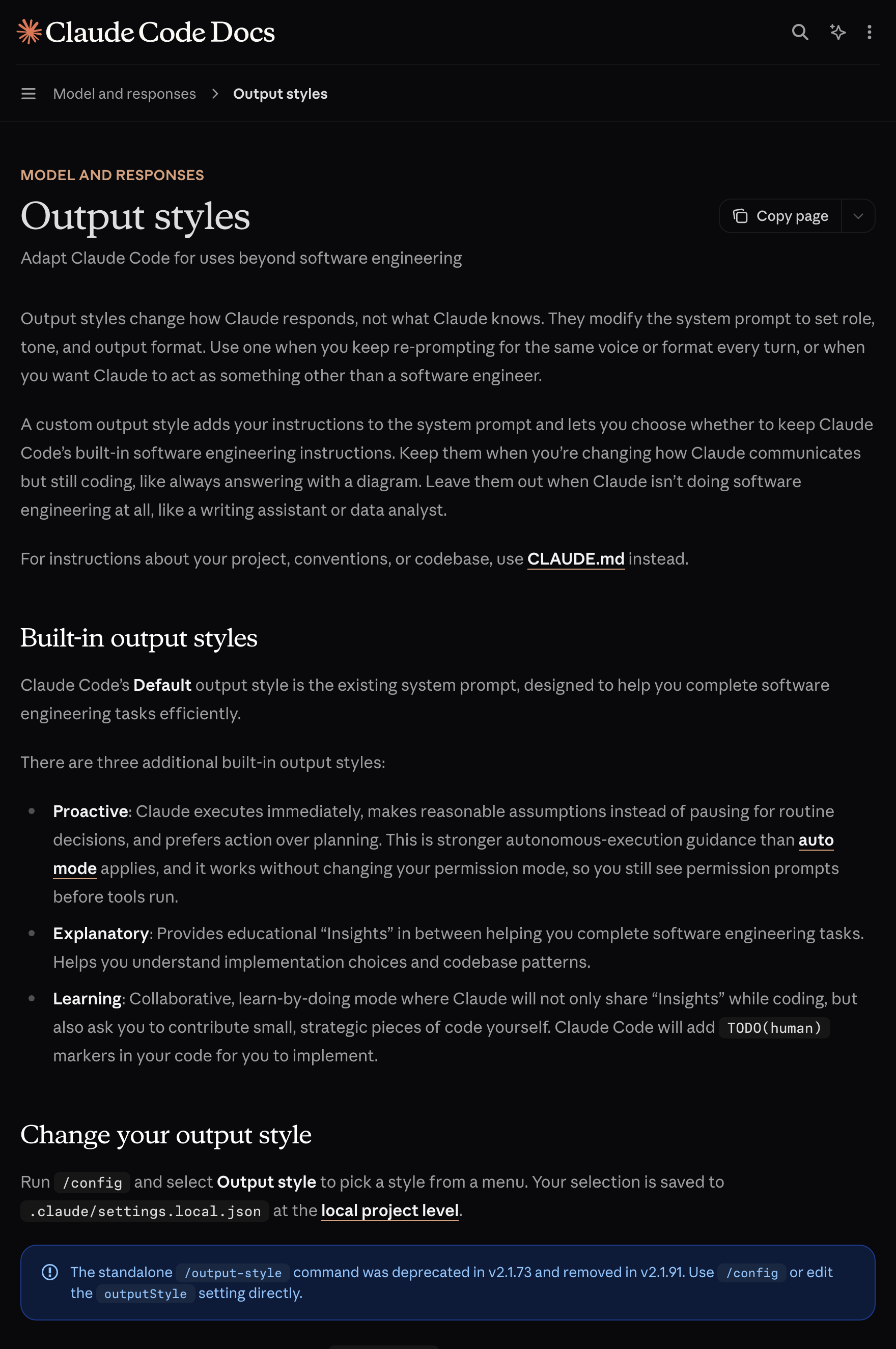
TODO(human) markers in the code for a person to fill in is documented too — meaning "not a tool that writes it for me but a senior engineer and teacher", as stated above, is not my personal usage but the definition of the style itself.| What is different | So |
|---|---|
| It makes you type terminal commands yourself | Your hands remember. Typed for you, you still cannot type it next time. |
| It gives context and intent alongside | What remains is not "this was done" but "this was done because of that". |
| It inserts insights along the way | Something learned remains after the task ends. |
- If a prompt could do it, there would be no reason to make it a setting. You would just paste it into every conversation.
- In practice no other service offers this. It is different in kind from the study guides in ChatGPT or Gemini.
- It is slower in exchange. The reason for using it anyway is single — I can only verify what I understand.
3-2-2 · Cost is part of the choice
| Tool | Billing | Result |
|---|---|---|
| Cursor | Metered API | The design was good but it got expensive with use. It makes you hesitate to experiment. |
| Claude Code | Flat rate · around $100/month | The same work can be repeated without cost arithmetic — part of why the 45-configuration experiment in §1 was possible. |
| Gemini | Family plan | Google offered it cheaply per family, and I started using it seriously from then. Which tool gets used when is sometimes decided by the pricing plan. |
| GitHub Copilot | — | If it were far cheaper perhaps, but Claude Code is not especially expensive, so there was no reason to move. |
3-3. Assessment of the models — strengths and limits
The limits appeared in different places for different models.
| Model | Where used | Limit observed there |
|---|---|---|
| Claude | Work overall | Confidently wrong (②) · in agentic loops tokens grow close to quadratically (③) |
| Upstage Solar | Service implementation | Works well as a tool-calling agent, but claims to know what it does not (①) |
| Gemini | Bulk input | On long transcripts, numbers and relationships break from the 2–3 hour mark (④) |
| GPT · Gemini | Images and video | Cannot draw logical development — plausible but wrong (⑤) |
| Local (8B·16B) | On-premise experiments | Weak on lesser-known localities and narrow domains (⑥) |
3-3-1 · Strengths — where the model earned its keep
| Strength | Model observed | Evidence |
|---|---|---|
| ① Set a principle and it follows without instruction | Claude | After nailing down "validation matters most" once in §1-2, the four verification mechanisms in §1-3 appeared without individual instruction. Follow-up work maintained that standard without being told each time what to verify. → What a human must set is the principle; repeatedly applying it can be delegated. |
| ② Told to criticize its own plan, it actually bites | Claude | Asked to argue against its own RAG experiment plan, it produced six valid objections — "there is no reason to explore even the free axis sequentially", "binary recall is a false signal on multi-answer questions", "do not trust the scores before label verification". All were flaws in my original plan, and all went into the experiment design. |
| ③ Context does not break in a large repository | Claude | Through file exploration → edit → execution it held on to earlier decisions. Code you cannot write by looking at a single file — such as an invariant check spanning several files — comes from that. |
| ④ It leaves the reasoning in writing | Claude | The prose quality is good enough that, alongside the code, why it was done that way survives as documentation. For someone who treats "can a successor pick this up" (§2) as the productivity metric, that was the point, not a side effect. |
3-3-2 · Limits — observed directly, per model
| Limit | Model observed | Evidence and conclusion |
|---|---|---|
| ① It claims to know what it does not | Solar | I built a library federated-search agent on the Upstage Solar API and it worked correctly. But when I named that service and asked "what is this", it answered as if it knew while it did not. → It can be trusted as an agent that calls tools, but you must not assume the model knows facts. Take facts from tools and source documents; leave judgment and assembly to the model. |
| ② Strength of confidence ≠ accuracy | Claude · Solar | Both ① and ③ below are cases of a model being confidently wrong. If confidence cannot be used as a signal, the only option is to make things falsifiable by structure. That is why the mechanisms in §1 were a requirement, not a choice. |
| ③ Non-linear cost growth | Claude | In an agentic loop that calls repeatedly to improve retrieval quality, tokens grew close to quadratically (about 81k · 27× the single-shot path — measured in §1-5-2). The quality gain was not proportionate. → On equal quality take the cheaper option; the loop was kept as a documented experiment. |
| ④ It does not read all of a long input | Gemini | Feeding meeting transcripts of 1, 2 and 10 hours, it held up to one hour and content began vanishing from two or three. Numbers and relationships in particular came out wrong. → Context size is a ceiling on accuracy, not a guarantee. Rather than inserting a lot, I moved to finding and inserting only what is needed (RAG). |
| ⑤ It cannot draw logical development | GPT · Gemini | Ask for matrix operations or network flows as images or video and the output is plausible but wrong. Korean infographics barely work either (GPT ✗ · Gemini ○). → I draw this part myself with Manim. Presentation can be delegated; logic cannot. |
| ⑥ Weak on small localities and narrow domains | Local (Ollama) | I have a benchmark of my own — "where is Gamman-dong?". It is a lesser-known neighbourhood in Busan, so whether a model has learned that far is a ruler for how much it knows. Local models (8B/16B class) said a lot of wrong things here. → Even so, there are places to use them. For short reactions like "nice · keep going" they are sufficient and affordable. But they cannot be used where judgment is required. |
3-3-3 · When to use what
| Situation | Choice | Reason |
|---|---|---|
| Exploration · learning · writing documents | Claude Code (learning mode) | Result and understanding both remain |
| Looking up a fact | Not the model — tools and source documents | Limit ① |
| Bulk repetitive processing | Single-shot first; loops only after measurement | Limit ③ |
| Sensitive data | Local execution or on-premise | Environments where data cannot leave the building really exist |
"워워.. 니가 다 짜면 안 된다. 우리는 공부중이고. 다시 전으로 돌아가서 개념노트를 보고 뭘할지 같이 고민하자. 내가 코딩을 하면서 공부할거고 … 너가 시니어라 생각하고 나를 가르쳐주면서 같이 파일을 만들고 하면서 공부해야지."
3-3-4 · The direction I am interested in
The cost verification in §1 could not send client data outside, and the meeting notes in §2 ran into the standard that "company material must not be handed to outside services". Most of the work I have done has been in places like that.
| Option | What I weighed |
|---|---|
| Local models | I have run them, but the level drops in narrow domains, so they cannot be used as they are. Useful for getting a feel. |
| Open-weight models | I intend to attach recently released ones to toy projects. But a model whose training process and alignment method cannot be inspected is hard to put where judgment itself becomes evidence. |
| Domestic on-premise | The option that actually remains where data cannot leave. Both cases in this document fall there. |
- Whenever domestic models come up, expectation and disappointment pour out together. I too saw the limits while using Solar, and I wrote that observation down as it was in 3-3-2 ①.
- But noise also means there is interest. Nobody is disappointed by something nobody expected anything from.
- And there is no obvious alternative. A model whose training process and alignment method cannot be inspected is hard to put where judgment itself becomes evidence — the cost verification in §1 was exactly such a place.
A.Appendix — making a running system verifiable by others
The claim in §2 is about an organization; this appendix is the record of applying the same principle to a system run by one person. It is not an organizational case, so it was moved out of the main text, but it sits on the same line as this document's theme — "make what AI wrote falsifiable by a third party".
The subject is a single-node k3s cluster I have run alone since 2025 — about 20 services under *.bit-habit.com run on it.
A-1 · How I got here
I passed a Linux certification in my first year of middle school. I passed it by rote, and I knew then that I had not understood it. I am thirty-eight now, so for 25 years since, I have been looking for ways to overturn that.
- 2022 · École 42 — set up VMs myself.
- 2023 · wrote Dockerfiles myself.
- 2024 · evaluating other people's k3s assignments made me want to take it up again.
- 2025 · put a server on the Oracle Cloud free tier.
- 2026 · built a k3s cluster on it and run it myself — around 20 services, with certificates, routing, deployment and incidents all in my own hands.
This cluster is the continuation of that, and I imposed the constraint myself — how far can one person get on one free machine. Four ARM cores, 20 services, $0 a month.
A-2 · What I asked the AI to do · did not
| Task | Who |
|---|---|
Collecting the cluster's actual state (kubectl measurements) | AI — the source to compare the document's claims against |
| Writing the 5-stage learning structure · checkpoints · glossary | AI — scaffolding |
| Deciding what to publish and what to record as a limit | Human — judgment |
| Touching the production cluster | Human — the AI is given no execution rights |
The result is infra.bit-habit.com. The source is in the public repository bookseal/bit-habit-infra, and the live state is checked externally every 60 seconds at status.bit-habit.com.
A-3 · Three marks of a falsifiable document
"The documentation is good" is an unfalsifiable claim. Instead I look at whether it is in a form a third party can compare against. Three things went in.
Secrets ❌ gitignored, applied by hand · Namespaces ⚠️ mostly a single default. And the conclusion is written in one line: "the gap from industry standard is not the tooling and not the services, it is secrets.""Writing down what you decided not to fix is part of the retrospective too. A known issue that is not written down is indistinguishable from an unknown one."
- The order of the path to GitOps was nailed into the document — encrypt secrets → per-app namespaces → ArgoCD.
- Why this order — reversed, it is written down that you "spend a week fighting a controller trying to sync a repository that does not hold the truth". Attach the tool first and syncing starts before the repository holds the real state.
- So there was no hurry — simply re-applying the manifests on every deploy was already giving
selfHeal, the property one actually wants from GitOps. - It is now proceeding in that order. When what to do and when is written in a document rather than felt in a mood, the next person can follow the same order.
A-4 · Incident postmortem — 200 OK
habit.bit-habit.com served a different site for months. Not an error page — a valid certificate and 200 OK, serving a perfectly wrong site. Because the uptime monitor and my own status page both asked only "did a 200 come back?", the incident was invisible to every automated check.
Diagnosis went by layer-wise bisection — at each step, ask "is the problem above or below this layer" and cut one side away. The decisive move was calling the app's Service directly from inside the cluster. The app was fine, so the fault lay in front of it. The real cause was two independent failures overlapping.
flowchart TB
  B["Browser requests
habit.bit-habit.com"]:::s2b --> T["Traefik reads the routing table"]:::s2b
  T --> F1["Failure ①
rule points at the wrong Service
portfolio ← not the app"]:::bad
  F1 --> N["nginx in the portfolio Pod
receives the request"]:::s2b
  N --> F2["Failure ②
no server_name matches this host,
so it falls back to the default block"]:::bad
  F2 --> R["200 OK + the wrong site
no error anywhere"]:::bad
  APP["Flutter app
fine · healthy · unreachable
0 traffic for 103 days"]:::ghost
  classDef s2b fill:#EFEBFE,stroke:#5B3FD9,color:#3B2A82,stroke-width:1.3px;
  classDef bad fill:#fdeeec,stroke:#a3241d,color:#7a1a15,stroke-width:1.6px;
  classDef ghost fill:#f2f2f4,stroke:#8a8a95,color:#55555f,stroke-dasharray:4 3;
The root cause was not a routing bug. It was a single-source-of-truth bug. The app existed only in the cluster and in no repository at all. So the one line pointing at that app lived in a file that did not know the app existed. An ownerless rule drifts, and nobody notices.
- Assert the content, not the status code — Gatus can require a specific string in the response body. One line per service turns "it responded" into "it responded as itself".
- Fix the file, not the cluster — fix only the live state and the next
applyquietly reverts it. - So the real fix was not one line of routing — the app that was in no repository was brought in, and its rule was separated out of the shared routing table (15 hosts) to sit beside the app, cutting the blast radius down to one site.
A-5 · Why I built it, and how I used AI
| Why | What I got |
|---|---|
| Learning was the point | I had seen k3s while evaluating other people's assignments, but without building it myself I did not know it. It is the standard I have kept for 25 years since passing a certification by rote in middle school — what must remain is understanding, not the artifact. |
| I wanted my own server | I wanted to see how far one free machine goes. Certificates, routing, deployment, incidents — once all of it passes through your own hands, you get a feel for it. |
- I did not have it install things for me. Instead I had it write an installation tutorial that accounts for this cluster's quirks — step-by-step exercises · quizzes · a progress checklist.
- My hands do the work. If the AI does it, I still cannot do it next time.
- For the same reason, collecting the cluster's actual state with
kubectlwas delegated to the AI. That is the source to compare the document's claims against, and a human transcribing it by hand is more likely to get it wrong.
- GitHub Actions connects to the server over SSH and runs
git reset --hard origin/main. - The key is bound in
authorized_keyswith a forced command — whatever command arrives, only the one fixed script runs. - So even if the key leaks, nothing more can be done with it.
B.Appendix — masking policy
Before publication, everything was substituted exhaustively against the following criteria and re-checked by searching again.
| Target | Treatment |
|---|---|
| Names of contracting authorities, agencies, clients | Replaced with [contracting authority] and similar |
| Internal team and unit names | Removed |
| Facility and site addresses | Removed (counts kept). Site names published by the government, such as the national observation network, are kept so the screens remain readable |
| Internal budget amounts in absolute terms | All removed; only ratios used (±1.7%, about 40%) |
| Internal file names | Replaced with generic names |
| Local paths · accounts | Removed or generalized |
| IPs · API keys · tokens · passwords | Removed after an exhaustive search of text and logs |
| Personal data (names, contact details, etc.) | Exhaustive search found none |
| Published documents such as the Standard Estimate Manual | Quoted as is, being published government material |
.gitignore was built on the standard that "statutory and manual PDFs are published documents, so include them; internal budget spreadsheets are excluded".
AI session logs are a learning asset but are not published as they are — terminal output drags along absolute paths, environment values and credentials, so the exporter script is tracked while its output is excluded.C.Appendix — public material
The public repositories and live sites that support each claim in the text. You can open them and check directly.
| What it supports | Repository · live |
|---|---|
| §1-4 ~ §1-6 Case 2 — ground-truth set · 45-configuration benchmark · grading code | github.com/bookseal/llm-app-lab llm-app-lab.bit-habit.com (live) |
| All of §2 — agent operating rules (CLAUDE.md) · ADRs · Board scripts | KIBA-Automation/project_management_with_ai_agent Raw meeting notes are private — meetings/ is excluded from git tracking |
| §3 limit ① library federated-search agent (built on the Solar API and working, but does not know its own name) |
github.com/bookseal/Booktoss booktoss.bit-habit.com (live) |
| Publishing the limits of the operating and observability infrastructure as open problems | github.com/bookseal/bit-habit-infra status.bit-habit.com (live status) |
What is not publishedThe repository for the cost-verification app, the central case of this document, is private because it handles client data. The §1 screens above have internal budget figures, survey site addresses and internal file names masked, leaving only the published Standard Estimate Manual (Appendix B). Not being able to show the strongest evidence as it is, is the price accepted in this kind of work.